Monday, May 27, 2013

The 2013 Big Book Short List


I’ve been so caught up in work and preparations for my trip to England next month for the Translators’ Coven that I completely forgot about today’s Big Book short list announcement! Before I head to the beach for some Memorial Day reading, here’s a quick list, in the order the books were listed on Lenta.ru:

I’m particularly looking forward to reading the Buida, Kucherskaya, and Levental novels, though I’m hoping to give all this year’s fiction a read. Off to the beach!

Disclosures: The usual, with direct and indirect ties to Big Book and many of the books on the list.

Sunday, May 26, 2013

The Doors of Deception: Pelevin’s Burning Bush

In a recent email conversation, a colleague and I talked about Viktor Pelevin not being my cup of tea, coffee, or cocoa… that was before I read Операция «Burning Bush» (Operation “Burning Bush”), the first piece in Pelevin’s Ананасная вода для прекрасной дамы (Pineapple Water for the Fair Lady). Burning Bush, like Omon Ra before it (previous post), didn’t turn me into a Pelevin fanatic, but the novella does—continuing with the drink theme—serve up some interesting glasses of kvass.


Kvass tank, 1997.
I don’t like kvass in real life, but I can’t help but appreciate the literary kvass served up in Burning Bush because Pelevin slips in an acid mickey: our first-person narrator, Semyon Levitan, is recruited for a special FSB project that requires training time—lots of training time—spent in a sensory deprivation chamber. While tripping on acid his FSB master puts in his kvass. Part of what makes this novella fun is that it involves none other than George W. Bush: Levitan’s initial mission is to speak, as God, with Bush through an implant in Bush’s tooth. Don’t worry, Levitan is an English teacher who’s more than capable of chatting with Bush.

I haven’t read a lot of Pelevin but I certainly recognized elements that felt like spillovers from Omon Ra: strange secret government programs that require strange secret training and result in strange secret deceptions. There’s also a spiritual element that plays off Daniil Andreyev’s Роза мира (The Rose of the World), a book I’ve never read. Someone once gave it to me as a gift but it got lost in transit somewhere between Moscow and Maine, in an ill-fated box that also contained Lolita, The Brothers Karamazov, and materials about evaluating NGO projects. I hope everyone’s coexisting somewhere in peace. The important thing here is that the references to Andreyev involve Stalin and Satan.

Pelevin generally tends to lose me somewhere, to some degree, and Burning Bush is no exception: I thought the novella worked best before Pelevin began referencing The Rose of the World. The problem isn’t so much that I hadn’t read Andreyev—there’s a chunk of text in Burning Bush, I’d already heard about The Rose of the World, and it’s easy to find background online—but that Pelevin’s use of Andreyev felt a little too heavy-handed to me as a part of the story, even though the Satan element itself fits just fine. I generally seem to think Pelevin’s satire and descriptions of twisted but almost realistic contemporary situations and characters are the best aspects of his books, so I was pleased Burning Bush is a more restrained piece than some others I’ve read—Numbers comes to mind—and doesn’t implode by getting too outlandish too fast.

Which is to say it was the light, fun stuff that made Burning Bush good evening reading material after some long work days. There was plenty to enjoy: Levitan’s ability to imitate voices, the very thought of someone chatting with Bush through Bush’s tooth, fun references to Russian poetry, Tony Blair, and American political and pop culture, including Pulp Fiction, which is wildly popular in Russia. Speaking of “light,” I’ve purposely gone light on some of the details in Burning Bush in case the novella is ever translated into English.

A Note on the NatsBest: The National Bestseller award is back, with new sponsorship from film company United Partnership and the television channel 2x2. The seven-member jury that will choose the winner includes two representatives from the new sponsors and two writers: Sergei Zhadan, whose Voroshilovgrad (previous post) I read in Zaven Babloyan’s Ukrainian-to-Russian translation, and Aleksandr Terekhov, who won last year’s NatsBest for Germans. This year’s winner will be announced on June 2.

Level for Nonnative Readers of Russian: 2.0 out of 5.0, though the book may have felt easier than it is because of the humor.

Russian Name: Виктор Пелевин

Up Next: I’m not sure! NatsBest, perhaps a mishmash of short stories or Leonid Iuzefovich’s Prince of the Wind… or letter S favorite writers…

Image Credit: Kvas vendor, 1997, in Kaliningrad/Königsberg/Koenigsberg, from MicHael Galkovsky, via Wikipedia. I remember seeing these kvass tanks on the street!

Sunday, May 12, 2013

A Jumble: Two Books, One Coven, and Six Literary Award Finalists

I took a break last week after a rather bloody incident involving a grater, a chunk of Pineland sharp cheddar cheese, and a middle finger. Now that I’m back to full typing capacity, despite an occasional twinge in the finger, here’s a jumble of a post to get me caught up…

I’ll admit that last week I was more than happy to procrastinate writing about Sergei Nosov’s Грачи улетели (The Rooks Have Flown/Left/Gone): in keeping with the jumble theme, The Rooks is a nearly indescribable jumble of characters, places, and motifs. Nosov tells the story of three old friends—a teacher, a typewriter repairman and watchman, and a former flyswatter salesman and would-be artist(e)—in three non-chronological sections. Much of the book is set in St. Petersburg, which lends itself to some nice passages about changing names and times. And references to Dostoevsky. And peeing off a bridge.

I thought The Rooks worked particularly well when Nosov examined contemporary art—one of his characters makes a wonderful trip to the Hermitage and stares in the abyss of Malevich’s glassed-in Black Square—and the fine lines between art and life. The section set in Germany, where the flyswatter salesman and would-be artist lives for a time and hosts the other two for a painful visit, felt less successful because it felt, simply, too long. Despite some structural misgivings, Nosov won me over with atmosphere, love for St. Petersburg, and a tone that avoids the cloying and preciousness thanks, in large part, to tart commentary on contemporary art and culture. The epilogue contains developments that brought varying degrees of surprise and showed how little we may know our friends and literary characters. It also cemented my interpretation of the book’s title as a reference to fall, playing off the name of Aleksei Savrasov’s painting of rooks that have returned in spring.


Iurii Trifonov’s Обмен (The Exchange) is a lovely jumble, too, a long story about family that blends past and present, private and public: Trifonov focuses on Viktor Dmitriev, whose wife Lena wants to arrange an apartment exchange so they (and their daughter) can live with Dmitriev’s mother, Ksenia, who is horribly ill. The description of The Exchange in Neil Cornwall and Nicole Christian’s Reference Guide to Russian Literature is so good and detailed (even if it’s cut off!) that I’ll just focus on impressions. I think what struck me most about The Exchange was the grayness of Dmitriev’s Soviet-era existence: his daily routine, his past affair with a co-worker he thinks would have made a better wife than Lena, and, of course, disappointment. Everything is beautifully observed and described though I find this sort of quiet—or perhaps muted and repressed?—desperation even sadder than the harsher chernukha of the post-Soviet era. I mean that as a statement of respect rather than a criticism. Particularly since I have to think there’s a reason Trifonov chose to include that cesspool.

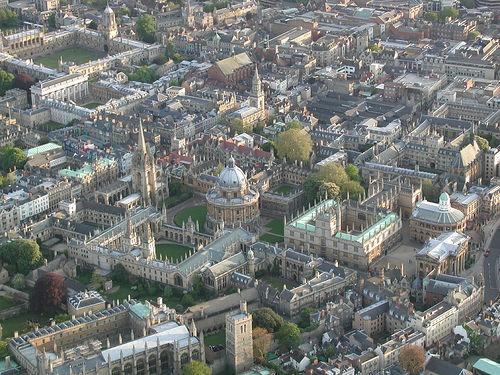
File:Oxford City Birdseye.jpg
Oxford from the air... must get up early enough to see city before coven...
On another note, I’m very excited about Translators’ Coven: Fresh Approaches to Literary Translation from Russian, a weekend workshop I’ll be attending at St. Antony’s College, Oxford, next month. I’ll be chairing a roundtable discussion about publishing and translations, and speaking on a panel about translating dialogue in drama. The week after the workshop, there will be a series of events about poetry translation at Pushkin House in London. A huge thank you to Oliver Ready and Robert Chandler for organizing all this. It’s a wonderful chance to learn and get caught up with London-based colleagues. I can’t wait!

Speaking of which… Pushkin House launched a new book award, the Pushkin House Russian Book Prize, “to further public understanding of the Russian-speaking world, by encouraging and rewarding the very best non-fiction writing on Russia, and promoting serious discussion on the issues raised.” I’m always vowing (and, generally, failing) to read more (okay, any!) book-length nonfiction that complements my fiction reading, so the Pushkin House Russian Book Prize short list, which covers a wonderfully broad assortment of topics, is a convenient place to start looking for candidates:
  • Anne Applebaum: The Iron Curtain: The Crushing of Eastern Europe 1944-1956
  • Masha Gessen: Man Without a Face: The Unlikely Rise of Vladimir Putin
  • Thane Gustafson: Wheel of Fortune: The Battle for Oil and Fortune in Russia
  • Donald J. Raleigh: Soviet Baby Boomers: An Oral History of Russia’s Post War Generation
  • Karl Schlögel: Moscow, 1937
  • Douglas Smith: Former People: The Last Days of Russia’s Aristocracy
FYI: Languagehat has posted about Soviet Baby Boomers and Moscow, 1937. Moscow, 1937 sounds particularly fun…

Reading Levels for Non-Native Readers of Russian: Medium for both the Nosov and Trifonov books.

Writer Names in Russian: Сергей Носов and Юрий Трифонов.

Up Next: A novella (or two?) by Victor Pelevin.

Image Credit: Oxford City Birdseye from SirMetal, via Wikimedia Commons.

Sunday, April 28, 2013

The Big Book 2013 Long List

This year’s Big Book Award long list, which came out last week, looks like a good one: beyond the four books I’ve already read and enjoyed very much, there are a couple books I wish I’d bought in Moscow, plus a nice clump of titles I’m interested in. There are 36 books on the list, meaning it’s a bit way too long to include everybody here. But here are some notes:

Four books I’ve already read and loved, with English-language titles linking to previous posts:

Three more books—in addition to 2013 NatsBest shortlister Laurus—have already won or been shortlisted for other major prizes:
  • Maxim Kantor: Красный свет (Red Light, though “свет” can also mean “world,” so I suspect dual meaning here). A novel with lots of twentieth-century history. NatsBest short list.
  • Aleksei Motorov: Юные годы медбрата Паровозова (Male Nurse Parovozov’s Young Years). Autobiographical fiction that won the readers’ prize in the 2013 NOSE award.
  • Aleksandr Terekhov: Немцы (Germans). Won the 2012 NatsBest. On the shelf for ages!
The two books I regret not buying when I was in Moscow… though only mildly because both are available online, in slightly condensed journal versions:
Books by writers I’ve read and enjoyed in the past:
In a column posted to Izvestiia after the short list came out, critic Liza Novikova noted four books of “documentary prose”:
That’s only sixteen books… I’ve heard or read about several more, particularly Denis Gutsko’s Бета-самец (Beta-Male), Denis Dragunskii’s Архитектор и монах (maybe The Architect and the Monk), and Igor’ Sakhnovskii’s Oстрое чувство субботы (A Keen Feeling of Saturday: Eight First-Person Stories), but that still leaves nearly half the list.

A few other books are available online:
  • Elena Makarova: Фридл (Friedl, which a reader tells me is a diminutive for names such as Friedrich and Friederike... the character in the book is a woman but it doesn’t appear that her full name is in the text.). The online “title page” says this is a documentary novel, and the first page clearly shows a World War 2 setting.
  • Andrei Volos: Возвращение в Панчруд (excerpts) (Return to Panjrud). Volos, who is originally from Dushanbe, often writes about Central Asia. His agent’s site says this novel is about a poet in the Middle Ages.
  • Nikolai Klimontovich: Степанов и Князь (Stepanov and the Prince).
  • Anton Ponizovskii: Обращение в слух (For the Ears? I get the feeling of something intended to be heard…). The quick description from the publisher: a novel about Russia and the Russian soul. The book’s Web site doesn’t explain much more, though the journal intro says the novel includes actual interviews.
Disclaimers: The usual, for all sorts of commercial and collegial reasons.

Up Next: Sergei Nosov’s Грачи улетели (The Rooks Have Flown/Gone/Departed/Totally Left Town). One of you wrote and asked why I didn’t use “flown” in the translated title for this book… The Rooks Have Flown certainly sounds better than my versions! I think I was stuck because the title of the Savrasov painting referenced here is often translated as The Rooks Have Returned or The Rooks Have Come Back. I’m still figuring out how I think the title fits the book, which has something of a shock ending.

Sunday, April 21, 2013

Plague and Apocalypse: Vodolazkin’s Laurus

Evgenii Vodolazkin’s Лавр (Laurus) combines lots of elements I enjoy in my fiction: a long-ago setting in the fifteenth century, guilt feelings, a focus on one ever-changing character, fear of apocalypse, curiously varied language, and, yes, even the bubonic plague. Best of all, to borrow from what one of you said about Laurus in an online conversation, the book is addictive. It just reads and reads and reads, drawing the reader through four “books,” sections that describe four stages—four separate lives, really—within the title character’s time(s) on earth, resulting in a simple structure that creates something akin to a life of a saint. 

What’s a bit complicated for my purposes here is that the title character is known by several names, frequently Arseny, so I’ll call him that, too. So many thematic elements thread through Laurus that I think I’ll approach the book through a few themes I particularly enjoyed rather than trying to explain who’s who and what happens… the result is a messy mishmash, but pretty much anything would feel awkward to me because Laurus feels so elegantly balanced and indescribably intimate.

The Plague and the Apocalypse. Why do the bubonic plague and the apocalypse fascinate me in fiction? I don’t know but I suspect it’s because they infect novels with existentialism via the threat of imminent death. Aloneness fits with them, too: Laurus includes children orphaned because of the plague. (Even Forever Amber, BTW, endeared itself to me forever because of the plague, and I’m not alone!) In Laurus, Arseny learns herbal healing from his grandfather, Christopher, and treats plague patients in neighboring villages, earning such a reputation that he’s commandeered by a prince. As for apocalypse, there are calculations for the end of the world. Death is ubiquitous, particularly since Arseny often lives, basically, on top of cemeteries. Also: the unchristened dead are scapegoats for all sorts of calamities.

Time and Reinvention. One of the most wonderfully jarring aspects of Laurus is the language Vodolazkin uses. I feel almost as if I should write “languages” since Vodolazkin mixes archaisms with contemporary language—dropping in thoroughly modern slang and bits of anachronistic historical and geographical information—to strangely good effect. Though it’s surprising to find a sentence that mentions that a monastery is located on the future Komsomol Square of Pskov, the out-of-time toponym reinforces Arseny’s thoughts that he lives outside of time. As Arseny tells his dead girlfriend, Justina, “…события не всегда протекают во временипорой они протекают сами по себе. Вынутые из времени.” (“…events don’t always flow in time… now and then they flow on their own. Pulled out of time.”). 

Time cycles around and around in Laurus as seasons and lives, with Arseny living through four “books” that cover phases that almost amount to four lives where he is, roughly, healer, holy fool, pilgrim, and monk. Toward the end, Arseny lives in a cave and loses track of years, though he still knows when it’s Sunday. He looks forward to being freed from time and decides the only word he needs to discuss time is однажды, a sort of “once” or “one day” word that reinforces the time when something happens, such as “Однажды он понял, что этого указания вполне достаточно.” (“One day he realized that this indicator was quite enough/all he needed.”) Vodolazkin also includes references to Christopher Columbus and Amerigo Vespucci, adding another layer to the reader’s perceptions of the temporal setting of Laurus. Also: years are occasionally given in both Anno Mundi and Anno Domini, establishing parallel calendars.

http://upload.wikimedia.org/wikipedia/commons/1/16/%D0%A1%D0%BE%D0%B1%D0%BE%D1%80_%D0%A0%D0%BE%D0%B6%D0%B4%D0%B5%D1%81%D1%82%D0%B2%D0%B0_%D0%98%D0%BE%D0%B0%D0%BD%D0%BD%D0%B0_%D0%9F%D1%80%D0%B5%D0%B4%D1%82%D0%B5%D1%87%D0%B8.JPG
Cathedral of St. John, Pskov.
And Lots More “Alsos”… Arseny’s friendships with Foma, a holy fool who saves Arseny more than once by explaining away Arseny’s erratic-seeming behavior (during his holy fool period), and with Ambrogio, an Italian who comes to Pskov and ends up as Arseny’s traveling companion for a trip to Jerusalem that includes travel through the Alps and a horrendous hurricane at sea… mystical scenes with a wolf… an assortment of apparent miracles… the importance of literacy and words, which can be fatal, as well as the greater and deeper importance of their meanings, something reinforced through Arseny’s many silences and Christopher’s written instructions about herbal medicine, documentation Foma tells Arseny he no longer needs because he treats patients by taking their sins onto himself… a multi-pronged “also”: the tremendous immediacy of Arseny’s relationships with God, himself, his sins, Justina, and nature… the occasional feeling of a Bruegel painting… lots of marginalia reading “ha ha” or “!!” and then, yes, tears at the end of the book even though I knew how it would end… and so on and so on… To sum up: Laurus’s closeness, which never felt claustrophobic, left me with the feeling I’d experienced a strange combination of medieval timelessness, agelessness, life, and death, all of which works inexplicably well thanks to Vodolazkin’s mélange of words.

Level for non-native readers of Russian: From average to very difficult, depending on what sentence you’re reading.

Disclaimers: The usual; I have multiple connections to this book.

Up Next: The Big Book long list will be out on Wednesday. Then Sergei Nosov’s very enjoyable Грачи улетели, which I guess I’ll call The Rooks Have Left or The Rooks Are Gone, to play on the title of Alexei Savrasov’s painting in which the rooks have returned. Then maybe some short stories that have unexpectedly come my way…

Photo Credit: Левкий, via Wikipedia, Creative Commons.