Showing posts with label soviet-era fiction. Show all posts

Sunday, June 13, 2021

Books by the Calendar: Charskaya’s School Year and Baranskaya’s Week

I think I’ve been an impatient reader during the last few months. I’m not sure if that’s because of some sort of strange psychological aspect of finally, finally, finally nearing the end of Proust – only half a volume to go, oh, will I be glad to finish! – or because I haven’t been interested in much of the contemporary Russian fiction in my new acquisitions cart. I’m suspecting the latter: I’ve long been moody about my reading choices and I’ve been feeling like nothing fits. Though when something fits (like Svetlana Kuznetsova’s Anatomy of the Moon), I devour it.

Fortunately, I amassed a good selection of twentieth-century books in recent months, leading to a reread of Natalya Baranskaya’s Неделя как неделя (A Week Like Any Other) and then a first reading of Lidia Charskaya’s Записки институтки (hm, maybe Notes of a Boarding School Girl?). They’re very, very different – not surprising given that A Week is dated 1969 and Notes is dated 1901 – and I enjoyed them both, perhaps largely because they’re short, tidy, straightforward works of prose that read easily yet won’t leave me alone. (Unlike Proust: ISOLT simply slithers from my memory!) Both works are also set within very delineated timeframes: Baransksya describes a week in the life of a harried working mother and Charskaya tells the story of a tween girl from Ukraine who’s sent to a boarding school in St. Petersburg.

I first read A Week Like Any Other (brief sample of Pieta Monks’s translation, here) about thirty years ago. I don’t remember if I read in English or Russian but do remember that A Week was generally mentioned along with the phrase “double burden” during discussions of feminism and the numerous work-and-home responsibilities Soviet women were supposed to handle. Olga, A Week’s first-person narrator, works with polymers for sewer pipes and roofs, and she breaks her story into daily installments. The week coincides with the time allotted for answering a questionnaire about family life, to learn why women aren’t having more children. Olga makes a glossary of key words for the topic, covering the Russian alphabet from “a” (аборт/abortion) to “я” (я/I), with words like illness, children, nerves, motherhood, and money in between.

Baranskaya’s writing isn’t beautiful and lovely but given the topic as well as the novella’s effect and pace, I feel like calling it something like “utilitarian” is far higher praise: she covers a week in fifty pages, outlining work problems (falling behind schedule, missing days because her children are sick, relationships with her co-workers, a dreaded political session), family duties (shopping during lunch breaks, housework, taking care of sick children), marital relations (honeymoon flashback, arguments when hubby doesn’t want to help), concerns about her hair, and much, much more. On Friday the thirteenth, she loses something at the office and admits she, too, feels lost. Olga’s candidness about flaws – her own, the system’s, her husband’s – and her unsentimental optimism (I think that’s what I’d call it), plus Baranskaya’s ability to describe the breakneck pace of Olga’s life, make A Week very affecting. That’s how I felt back in the eighties and that’s how I feel now, too, particularly because I read it during a very stressful week, though at least my problem (a severe case of feline non-recognition aggression) could be resolved within a quick couple of weeks, unlike, say, the timesuck of Soviet-era food shopping. Read now, A Week feels like a period piece in some senses (again: Soviet-era shopping procedures) but that’s a plus because the novella feels so true to life, whether you remember those years (I do, albeit a bit later) or are learning about them from literature and history books. What gives A Week its emotional power is Olga’s straightforward (that word again!) account of her feelings, personal situation, and all that rushing, things I think most of us can relate to even now in 2021, if only on some lesser level. Languagehat also wrote about A Week; he researched a literary reference in the text.

Charskaya’s Notes generates empathy differently: this novel(la?) about a girl who leaves home for boarding school and makes friends with Nina, a Georgian princess (!) is sweet and might verge on saccharine if its portrayal of affection and friendship, beloved schoolmates and teachers, and family ties didn’t feel so heartfelt. I came to love the characters, too. Notes is something of a tear-jerker, so, yes, dear reader, I finished the book with damp eyes and a lump in my throat. Lyuda, the first-person narrator, is the daughter of a famous, heroic, and fallen Cossack officer – this is why Lyuda’s given a spot at a school so fancy that (mild spoiler alert!) royals come to visit the school, including Lyuda’s classroom. (And of course Sa Majesté Impériale knows her father’s name.) Among the quirky details of the time: he hands out cigarettes as souvenirs.

Charskaya, who apparently wrote the book from her own notes and experiences, focuses on a defined temporal setting: most of a school year, working in celebrations of Christmas and Easter that bring to mind Pasternak’s Zhivago, where the church calendar has significance. (Charskaya’s Wikipedia page does mention Pasternak, hm...) Descriptions of Christmas are lovely, with trees and tasty care packages, but Lent and Easter were more interesting, for confessions and forgiveness – Lyuda wants to forgive everyone and even confesses to throwing balls of bread at her friends – as well as a harbinger of death. I think my favorite aspect of Notes, though, is the day-to-day: nervousness when answering in class, descriptions of the dortoir, mentions of sweets and dining hall offerings, and rivalries among the girls. Nothing goes to waste here: an episode where Nina brings a crow into the classroom and is punished for it reveals many girls’ generosity. It also made me laugh.

My book with Notes also includes a prequel that tells Nina’s story. It’s apparently much beloved, though I’m not sure I want to read it. Nina’s a good character – smart, sharp, loyal to those she loves – and she’s proud of her heritage but I think I’d rather leave her story and Lyuda’s stories as they are for now. Judging from comments on Russian book sites, Notes is popular among young readers. I’m sure I would have loved it at Lyuda’s age (elevenish), and I enjoyed it very much now, both as a sentimental tale (no spoilers!) and as a very vivid, detailed, exuberant, and often humorous account of a certain angle on a (fictionalized) life at the turn of the last century.

Up Next: Big Book finalists. Vodolazkin’s History of Island, yes, I’m still reading; I’m also translating a brief excerpt. Svetlana Kuznetsova’s Anatomy of the Moon, which I’m translating, meaning I keep discovering and connecting more and more details. Belyaev’s The Air Seller.

Sunday, July 29, 2018

Farewell to Vladimir Voinovich

I was very sad to learn on Friday evening that Vladimir Voinovich had died. I haven’t read Voinovich in nearly a decade but I’ve enjoyed his books since the 1980s, first in translation—I believe Richard Lourie’s Moscow 2042 translation was the first Voinovich book I read—and then in Russian, where I think I first read Хочу быть честным (“I Want to Be Honest”), which is also one of the first medium-sized works of Russian literature I read for fun. I read Voinovich most recently in 2009, when I thoroughly enjoyed his Шапка (The Fur Hat) (previous post).

My early reading of Voinovich is certainly one reason I feel a certain sentimental attachment to his writing—his satire was biting and being able to enjoy it felt like a gift—though I’m sure that hearing him read at a very small Moscow gathering in the 1990s helped, too. I didn’t know him or even speak with him that evening but, as often happens after author readings, I felt closer to his work because I heard his voice and saw his mannerisms and reactions. Northwestern University Press’s description of Richard Lourie’s Pretender to the Throne translation sums up, in five words, what I’ve always so appreciated about Voinovich: “dissident conscience and universal humor.”

Voinovich’s death feels very much like the end of an era, though that’s not just because he was 85 and so few writers of his generation are still with us. I’m also afraid that younger readers aren’t as familiar with his books (and books by other Soviet-era dissidents, too) as they might be. I remember lending Chonkin books to two twenty-something Russians during the 2000s: neither had heard of Voinovich but both thoroughly enjoyed the reading. I hope Voinovich continues to be read. I also wish there were an afterlife with a special pneumatic tube for sending us work by departed writers. I can only imagine that Voinovich’s accounts of heaven/hell/limbo would be a lot of fun to read.

Other previous posts about Voinovich:

Up next: Sergei Kuznetsov’s Teacher Dymov, Janet Fitch’s The Revolution of Marina M., and Vladimir Sharov’s The Rehearsals in Oliver Ready’s translation. And Vladimir Danikhnov’s weird Lullaby, a Booker finalist about serial killings that has shades of Platonov. And Grigory Sluzhitel’s Дни Савелия, literally Savely’s Days, narrated by a Moscow cat. I’m also working on my Big Book reading, with Alexander Arkhangelsky’s Бюро проверки (Verification Bureau).

Saturday, July 5, 2014

Mamleyev’s The Sublimes

What can I say but “finally”?.. I admit I’ve been dreading, almost since I read its first pages, writing about Yuri Mamleyev’s Шатуны, a dark “metaphysical realist” novel known in Marian Schwartz’s translation as The Sublimes. In fact, I’d been dreading it so much I even considered combining two books in one post: The Sublimes and Danzig Baldaev and Sergei Vasiliev’s Soviets, which I wrote about in early May.


That combination isn’t quite as crazy as it might sound: Baldaev’s grotesque caricatures offer perspectives on the soul-sucking Soviet system and one of the main characters in Mamleyev’s novel, which was written in what Mamleyev calls the “deep underground” in 1960s Moscow, is Fyodor Sonnov, who seeks souls, a process that requires death and, thus, makes Fyodor a serial killer, albeit one with rather loftier-than-usual intentions. Sonnov starts killing early in the book, all very casually, not long after his stomach has been described as his second face and not long after he’s punched someone in the jaw for no apparent reason. Sonnov knifes his victim, checks his passport in the moonlight, and then starts chatting.

Юрий Мамлеев - ШатуныLike Mamleyev, Sonnov goes underground, too, both literally and figuratively, adding to a Dostoevskian mood that goes way beyond sharing a name with the writer. Sonnov stays with his sister Klava, who lives in a house near Moscow with some interesting characters: there’s Lidochka, a bug freak, and Petenka, who eats his own skin diseases. Meaning he eats himself. All of this feeds into myriad human and metaphysical mysteries related to themes like “Do I exist?” (I’ve only mentioned some of the marginally odd characters here, saving the most peculiar for readers to discover on their own. If you’re like me, you might wonder if you’re understanding things properly… Yes, you are. Some parts of this book may not be for the faint of heart...) The passages with the Sonnovs toward the beginning of the book felt almost like a mix of chernukha (dark, realistic fiction usually associated with the 2000s), surrealism, and something syntactical (I’m not quite sure what) that reminded me of Platonov, albeit without the heart-piercing beauty I find in Platonov. It’s Dostoevsky that rules, though: his portrait even appears in a reflection, complete with a firm and suffering gaze.

The Sublimes lost a lot of its energy for me when Mamleyev introduced a band of intellectuals: it felt like they sucked (oops, that was initially “fucked,” a nice little slip because of one of Sonnov’s capers…) the soul out of the book. I hasten to add that my problem with the band of intellectuals is but a symptom of my own biases: I’ve long had difficulty with philosophizing characters (cf. this previous post on Bykov’s The List) because they almost always feel heavy-handed and obvious to me. That’s not to say I didn’t enjoy certain passages with some of Mamleyev’s chattier characters, particularly Anna, the “metaphysical courtesan”; there’s even a beer-drinking scene at a cemetery. Still, so much talk about the “я” (the “I”) and solipsism tends to drag almost any reading for me.

That said, The Sublimes got under my skin like one of Petenka’s afflictions, coming close to making me scratch until I bled. I think I have a sense of why some readers love it so much: beyond the fact that lots of people enjoy the philosophizing I find so tedious, I have to admit Mamleyev does a fantastic job creating a world that’s both familiar and alien, a place that feels like some strange circle in some strange Soviet hell. The Sublimes is loaded with oppositions—life/death, presence/absence uneducated/intellectual, I/other—and there is, crucially, I think, a lot of laughter toward the end. Both Mamleyev’s laughter, written into the book, and mine, written in the margins. I even wrote a big “Ha!!” when Fedya hopes to kill all the metaphysicals: he’s in Moscow, in a place that seems like the foothills of Hell and he’s breathing in the smells of извращение, which feels to me like all sorts of perversion and distortion. My “Ha!!” wasn’t just because I disliked the metaphysicals. It also came from something wonderfully, hmm, ironic and unreal and realistic and maybe sublime about Fedya, who even takes pleasure in the smell of that perversion/distortion as he inhales.

And so even if I didn’t always enjoy The Sublimes, I can’t help but appreciate Mamleyev’s vision and off-kilter humor, both of which I (obviously) find a little indescribable. That brings me to one last thought: I’m glad I dreaded writing about The Sublimes. As often happens, my thoughts and feelings about the book settled with time, helping me appreciate The Sublimes, a book that is, whether I like it or not, a modern classic. I’ve included some links below with other views and particularly recommend Grigory Ryzhakov’s concise description and analysis. Finally, I have a feeling Mamleyev is a writer—like Sorokin and Pelevin—I will grow to appreciate, perhaps even enjoy, far more as I read more of his books and delve further into his themes and unusual world(s).
  • An excerpt of Marian Schwartz’s translation of The Sublimes on BODY
  • Publisher Haute Culture’s page for The Sublimes: download the bilingual book for free! Legally! [Edit!] Deluxe, custom-made, signed hard copies are available, too, for 2000 euro.
  • An interview with translator Marian Schwartz
  • Material on literalab about The Sublimes
  • Grigory Ryzhakov’s blog post about the book, which includes excellent links toward the end
  • Phoebe Taplin’s review of The Sublimes for Russia Beyond the Headlines
  • Russian Wikipedia page for Шатуны, very helpful for the character list

Disclosures/Disclaimers: The usual.

Up Next: We’ll see!

Sunday, May 12, 2013

A Jumble: Two Books, One Coven, and Six Literary Award Finalists

I took a break last week after a rather bloody incident involving a grater, a chunk of Pineland sharp cheddar cheese, and a middle finger. Now that I’m back to full typing capacity, despite an occasional twinge in the finger, here’s a jumble of a post to get me caught up…

I’ll admit that last week I was more than happy to procrastinate writing about Sergei Nosov’s Грачи улетели (The Rooks Have Flown/Left/Gone): in keeping with the jumble theme, The Rooks is a nearly indescribable jumble of characters, places, and motifs. Nosov tells the story of three old friends—a teacher, a typewriter repairman and watchman, and a former flyswatter salesman and would-be artist(e)—in three non-chronological sections. Much of the book is set in St. Petersburg, which lends itself to some nice passages about changing names and times. And references to Dostoevsky. And peeing off a bridge.

I thought The Rooks worked particularly well when Nosov examined contemporary art—one of his characters makes a wonderful trip to the Hermitage and stares in the abyss of Malevich’s glassed-in Black Square—and the fine lines between art and life. The section set in Germany, where the flyswatter salesman and would-be artist lives for a time and hosts the other two for a painful visit, felt less successful because it felt, simply, too long. Despite some structural misgivings, Nosov won me over with atmosphere, love for St. Petersburg, and a tone that avoids the cloying and preciousness thanks, in large part, to tart commentary on contemporary art and culture. The epilogue contains developments that brought varying degrees of surprise and showed how little we may know our friends and literary characters. It also cemented my interpretation of the book’s title as a reference to fall, playing off the name of Aleksei Savrasov’s painting of rooks that have returned in spring.


Iurii Trifonov’s Обмен (The Exchange) is a lovely jumble, too, a long story about family that blends past and present, private and public: Trifonov focuses on Viktor Dmitriev, whose wife Lena wants to arrange an apartment exchange so they (and their daughter) can live with Dmitriev’s mother, Ksenia, who is horribly ill. The description of The Exchange in Neil Cornwall and Nicole Christian’s Reference Guide to Russian Literature is so good and detailed (even if it’s cut off!) that I’ll just focus on impressions. I think what struck me most about The Exchange was the grayness of Dmitriev’s Soviet-era existence: his daily routine, his past affair with a co-worker he thinks would have made a better wife than Lena, and, of course, disappointment. Everything is beautifully observed and described though I find this sort of quiet—or perhaps muted and repressed?—desperation even sadder than the harsher chernukha of the post-Soviet era. I mean that as a statement of respect rather than a criticism. Particularly since I have to think there’s a reason Trifonov chose to include that cesspool.

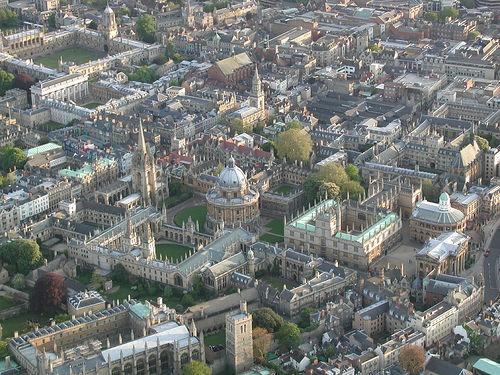
File:Oxford City Birdseye.jpg
Oxford from the air... must get up early enough to see city before coven...
On another note, I’m very excited about Translators’ Coven: Fresh Approaches to Literary Translation from Russian, a weekend workshop I’ll be attending at St. Antony’s College, Oxford, next month. I’ll be chairing a roundtable discussion about publishing and translations, and speaking on a panel about translating dialogue in drama. The week after the workshop, there will be a series of events about poetry translation at Pushkin House in London. A huge thank you to Oliver Ready and Robert Chandler for organizing all this. It’s a wonderful chance to learn and get caught up with London-based colleagues. I can’t wait!

Speaking of which… Pushkin House launched a new book award, the Pushkin House Russian Book Prize, “to further public understanding of the Russian-speaking world, by encouraging and rewarding the very best non-fiction writing on Russia, and promoting serious discussion on the issues raised.” I’m always vowing (and, generally, failing) to read more (okay, any!) book-length nonfiction that complements my fiction reading, so the Pushkin House Russian Book Prize short list, which covers a wonderfully broad assortment of topics, is a convenient place to start looking for candidates:
  • Anne Applebaum: The Iron Curtain: The Crushing of Eastern Europe 1944-1956
  • Masha Gessen: Man Without a Face: The Unlikely Rise of Vladimir Putin
  • Thane Gustafson: Wheel of Fortune: The Battle for Oil and Fortune in Russia
  • Donald J. Raleigh: Soviet Baby Boomers: An Oral History of Russia’s Post War Generation
  • Karl Schlögel: Moscow, 1937
  • Douglas Smith: Former People: The Last Days of Russia’s Aristocracy
FYI: Languagehat has posted about Soviet Baby Boomers and Moscow, 1937. Moscow, 1937 sounds particularly fun…

Reading Levels for Non-Native Readers of Russian: Medium for both the Nosov and Trifonov books.

Writer Names in Russian: Сергей Носов and Юрий Трифонов.

Up Next: A novella (or two?) by Victor Pelevin.

Image Credit: Oxford City Birdseye from SirMetal, via Wikimedia Commons.

Sunday, September 11, 2011

More Awards News & a Bit on Grekova’s Faculty

There are weeks (like, say, last week) when it feels like I can’t check my blog reader or Lenta.ru without finding more news about Russian literary awards. Book of the Year winners were named on Wednesday at the Moscow International Book Fair, and I was pleased to see that an eight-volume edition of works by Andrei Platonov, published by Vremia, won the main Book of the Year prize. Prose of the Year went to Olga Slavnikova’s Lightheaded (previous post); the other nominees in the prose category were Mikhail Shishkin’s Letter-Book (previous post) and a book of essays about history by Iakov Gordin. OpenSpace.ru has a full list of winners here, and some short lists are available here.

Then the Yasnaya Polyana award announced its six-book short list on Friday. I don’t know much about any of these writers or books but that, of course, is why I so enjoy following prize lists. The winner will be announced in late September or early October.

  • Ergali Ger’s Кома (Koma) – This novella/long story starts with the phrase “Родом Кома была из Рыбинска”—“Koma was a native of Rybinsk”—which got me interested because I once spent a couple days floating around the Rybinsk Water Reservoir on a research vessel and eating fresh fish.
  • Elena Katishonok’s Жили-были старик со старухой (Once There Lived an Old Man and His Wife) (excerpt) – This book was a Booker finalist in 2009.
  • Natal’ia Kliuchareva’s Деревня дураков (Village of Fools) – Kliuchareva is the only writer of the six that I’ve read so far: one of her stories is in the Rasskazy collection. It was one of my favorites. I still, BTW, highly recommend Rasskazy (previous post).
  • Irina Mamaeva’s Земля Гай (Gai Land, where Gai is the name of a settlement)
  • Iurii Mamleev’s Русские походы в тонкий мир (perhaps Russian Hikes/Campaigns Into a Subtle World?) – I still haven’t read much Mamleev, beyond a couple very short stories that I read at the beach recently.
  • Dmitrii Shevarov’s Добрые лица (Kind Faces)

As for I(rina) Grekova’s Кафедра (The Faculty): I realized I don’t have much to say about the book. After Grekova’s shorter Ship of Widows, Hairdresser, and Little Garusov, The Faculty felt a bit long and dispersed: the novel is composed of episodes in the lives of a math (cybernetics, I believe) department’s faculty members and students. The episodes are linked with various degrees of looseness and tightness; lives overlap like my beloved Venn diagrams. Grekova’s writing is, as usual, very readable, and she offers lots of insights and details on life, family, friendship, work, and death, reflecting Soviet reality… despite all that, plus Grekova’s tremendous compassion for her characters, The Faculty didn’t feel, well, special, compared with the other works I’ve read. I think the problem—a relatively minor one, I suppose, since I didn’t skim—is my preference for more tightly focused narratives.

Up Next: Well, there’s Leonid Girshovich’s “Вий”, вокальный цикл Шуберта на слова Гоголя (a title I’ve seen translated as “Viy,” Schubert’s Songs to Gogol’s Words), which I still think is peculiar. I’m also finding it a little repetitive and/or plodding, and definitely very showy so am going to do something I don’t usually do: read a chapter a day but focus more on another book, Sergei Kuznetsov’s Хоровод воды (Water’s Round Dance or The Round Dance of Water), a Big Book finalist. An excerpt, with comments from Kuznetsov, is on Snob. By coincidence, Kuznetsov’s book, which two friends recommended to me very highly, mentions the Rybinsk Water Reservoir in its early pages. Let’s hope this is a sign that it will help me break a streak of unsatisfying books.

Disclosures: Tin House, publisher of Rasskazy, is a publisher I enjoy speaking with about translated fiction.

Monday, November 22, 2010

How Far Away Is 2042? & Misc.

Though Vladimir Voinovich’s (Москва 2042) Moscow 2042 doesn’t feel quite as fresh now as it did when it came out in the ‘80s – will people anywhere watch TV in 2042? – it’s still plenty fun, and it still feels painfully relevant. I think the last name of one of the characters, “Karnavalov,” sums up a lot about the book: this satirical, dystopian novel written by an exiled writer certainly serves up a nice dose of carnival and, of course, absurdity.

So what happens? In 1982, Kartsev, a Russian writer living in Germany, boards a special Lufthansa flight that takes him to 2042 Moscow. Some of Kartsev’s acquaintances from his years in the Soviet Union – including Sim Simych Karnavalov, a reclusive writer who rather resembles Solzhenitsyn – express interest in his travel. I don’t think it will surprise many readers when they reappear in 2042 Moscow. Moscow in 2042 is ruled by a leader called the Genialissimus whose real name (sort of) is Berii Ilich Vzroslyi. His first two names refer to past leaders, and his last translates to “adult.” The names are part of the book’s fun: other characters include Dzerzhin (from Dzerzhinskii) and Gorizont (horizon).

Voinovich works a lot into less than 400 pages. There’s Kartsev’s writerly jealously of Karnavalov, a 2042 regime that combines religion with politics (hmm…), very funny scenes of collective writing processes, reflections on reality, and lots of poop humor. I’ll take Voinovich’s writing about “secondary” material over Sorokin’s any day, particularly since most of it – such as Kartsev finding himself in the “Third Kaka” – makes a point without being ponderous. Citizens in 2042 turn in their waste so they may eat… and there are multiple mentions of that staple Russian food, sausage. Moscow 2042 also includes references to classic literature, a special showing of Dallas, word play in the names of communist institutions, and a special isolation for Moscow. I don’t want to write more, lest I spoil the fun. I’ve always enjoyed Voinovich and would certainly recommend Moscow 2042 to anyone who enjoys dystopian satire, a bit of time travel, and humor both high and low. Moscow 2042 is available in translation.

The Big Book Award announced today that Viktor Pelevin’s t won its readers’ choice award; 8,615 readers voted over the Internet. Evgenii Kliuev’s Андерманир штук (Something Else for You) was second-most popular among readers; the book was a little too messy and wandering for me to love but I’m sure it won readers over with its magical atmosphere and positivity (previous post). Mikhail Gigolashvili’s Чертово колесо (The Devil’s Wheel), which I did love, took third (previous post). The jury’s selections will be named tomorrow.

My blogger colleague Marie Cloutier, a.k.a. Boston Bibliophile, interviewed me as part of her November Russo-Biblio Extravaganza. I thoroughly enjoyed answering her questions but it’s been even more fun reading her takes on some Russian books I should read one of these days. I’m especially looking forward to her thoughts on Moscow 2042.

Up Next: I’m still mulling over Dovlatov’s underwhelming Zone and working my way through Baldaev’s Drawings from the Gulag, a unique and important book that I’ve been reading in small installments. I’m continuing the theme by rereading Solzhenitsyn’s (In) The First Circle. More immediately: I’ll report on the Big Book Award winners tomorrow…

Sausage photo credit: adauzie, via sxc.hu

Tuesday, July 20, 2010

Grossman’s Mysterious Everything Flows

It’s never easy to write about unfinished books, and the difficulty multiplies when the book is as serious in subject and diverse in form as Vasilii Grossman’s Всё течёт (Everything Flows): Grossman writes about history, freedom, and Soviet prison camps, incorporating a combination of fictional characters and essay-like passages. The main narrative line in Everything Flows concerns Ivan Grigorievich, who is released from prison after 30 years, but Grossman interrupts Ivan’s story many times to describe and illustrate aspects of Soviet totalitarianism.

I admit: I get frustrated when a book moves so much between different types of narration. I admit: I didn’t read all the portions on history very carefully. And I’ll also admit: I’m one of those ridiculously stubborn readers who gets used to a character and then wants to stay with him or her. And Ivan’s story is compelling. Grossman shows us, with heartbreaking details large and small, Ivan’s awkwardness as he returns to “everyday” life outside the camps. He doesn’t fit with the parquet floor and chandeliers at his cousin’s apartment, and he feels that both he and Leningrad have changed. Though life outside the camps is frightening, he prefers freedom.

Grossman also tells of wives imprisoned for refusing to denounce their husbands. And a woman Ivan lives with tells of her experiences during the Ukrainian holodomor. Grossman makes their stories so immediate and poignant that I didn’t want to leave them, either. Robert Chandler, who translated Everything Flows for New York Review Books with Elizabeth Chandler and Anna Aslanyan, says in an interview with Book Serf that there is something distinctive about Grossman’s “vivid” selection of details. Those details – as varied as protruding lower teeth, Ivan’s job in a locksmith workshop, and the whitewashing of walls in houses where people died during the holodomor – result in writing that is both lyrical and documentary.

The long passages about Lenin, Stalin, and freedom, and a sketch composed of dialogue held my interest far less than the purely fictional chapters, despite Grossman’s choice of subjects: informants, Lenin, Stalin, and what they did to the Soviet Union. Toward the end, Grossman stresses that human history is the history of freedom.

The book cohered for me, rather mysteriously, in its last two pages, when Ivan returned to his father’s home. Somehow, all the disparate pieces and figures in Everything Flows ended up melding into something bigger, probably because Grossman’s conclusions about humanity and freedom were so movingly generous in acknowledging human flaws that they left me with a lump in my throat.

Everything Flows is, like Life and Fate, (previous post), not an easy book to read, and it’s probably obvious that I don’t feel very comfortable writing about it, but I think the fictional passages alone make it worth reading. Readers who prefer nonfiction might say the same about the passages about history.

Level for Nonnative Readers of Russian: 3/5, medium difficulty.

For more:

“Anti-Socialist Realism” on TNR.com

A review of Everything Flows from The Guardian

Also: The Road, a collection of Grossman’s fiction and nonfiction, translated by Robert Chandler, Elizabeth Chandler, and Olga Mukovnikova, will be available from New York Review Books in late September 2010.

Next up: Vladimir Sorokin’s Sugar Kremlin, then two detective novels by Leonid Iuzefovich.

Sunday, May 9, 2010

War Stories for Victory Day: Another Grekova Novella & a Sorokin Short Story

With so many news articles about this year’s Victory Day parade in Moscow, I’ve been thinking a lot about World War 2 and Russian fiction related to the war. I hadn’t realized until this week how many novels with war themes I’ve read in the last several years. I wrote a Victory Day post two years ago (here) and will add to my list of favorites at the end of this entry.

I just finished reading two pieces about the war: Irina Grekova’s 1969 novella Маленький Гарусов (Little Garusov) and Vladimir Sorokin’s short story “Кисет” (“The Tobacco Pouch”), from a collection dated 1979-1984. Little Garusov tells the story of a boy orphaned during the war who never quite grows, physically or emotionally. Garusov has a similar feel to the two other Grekova novellas (here and here) that I’ve read: clear, simple language, straightforward narrative, and a combination of light and heavy details that make the piece feel like life.

Though I agree with Helena Goscilo’s criticism (in this detailed introduction to Cathy Porter’s translation of Grekova’s Вдовий пароход (The Ship of Widows)) that Garusov meanders, I still found it an interesting portrait of the short- and long-term effects of the war on children. As a small child in wartime, Garusov often acts like an adult: he catches a crow and brings it to his mother for soup then, later, after she disappears and he’s sent to an orphanage that’s evacuated for the duration, he articulately convinces authorities to send him and his orphanage mates back to Leningrad. He wants to find his mother.

As an adult, Garusov marries and divorces, falls for “other” women, often feeling pity for them and lending money he doesn’t have. He can’t find happiness. He doesn’t know when he was born. His life is pretty empty. And sad. Garusov reminded me a lot of Liudmila Ulitskaya’s Искренне ваш Шурик (Sincerely Yours, Shurik), also about a youngish man who can’t quite seem to find his own life. Shurik was my favorite Ulitskaya novel until I read her Даниэль Штайн, переводчик (Daniel Stein, Translator) (previous post), another book with World War 2 themes.

Today I read Vladimir Sorokin’s “Tobacco Pouch” thanks to a recommendation from readers Languagehat and Alexander/Sashura; Sashura mentioned the story in a comment to this Languagehat post about Elif Batuman’s The Possessed. “The Tobacco Pouch” begins with a narrator, who loves the Russian forest, going to wait for sunrise in the woods. I’ve only read a bit of Sorokin – Лёд (Ice) (previous post) and a few stories, including “Чёрная лошадь с белым глазом” (“Black Horse with a White Eye”) (mentioned here) – but the idyllic, even kitschy, start of “Tobacco Pouch” made me wonder what sinister twist awaited in the woods.

I didn’t have to wait long: several pages in, a veteran with a chest full of medals appears. He’s out collecting plants and he carries a tobacco pouch given to him by a woman when he was a soldier. Then comes the twist: the sunrise lover asks the veteran to tell about the tobacco pouch, and the veteran’s speech eventually self-destructs (I borrowed that word from a small chunk of this interesting Russian essay about Sorokin) as he tells about his life after Victory Day in Berlin. “The Tobacco Pouch” reminded me a little of Gogol’s “Записки сумашедшего” (“Diary of a Madman”), where the narrator loses more and more of his mind as the story progresses.

One especially interesting aspect of the story: Sashura mentioned “Кисет” in a comment on an earlier Languagehat post, calling lily of the valley (ландыш), which the veteran gathers, a clue to the story’s meaning. Lily of the valley is the plant in the online version of the story but in my book, the veteran collects подснежники, snowdrops. The discrepancy got me Googling, and I found that both plants contain compounds used to improve memory: galantamine, in snowdrops, is used to treat Alzheimer’s disease, and lily of the valley, according to Wikipedia, contains of compounds for memory and the heart. [Edit: Both plants are also considered poisonous.] I’m glad Sashura mentioned the plants. Though I was suspicious enough to circle the word подснежники as I read, I didn’t link it to the linguistic breakdown and fragmented memories. “The Tobacco Pouch” didn’t become an instant favorite and I’m still mulling it over but it’s an interesting take on memory and, I think, the odd things that happen when we wander into literal, metaphorical, historical, and folkloric forests.

As for recommendations… Beyond the pieces I mentioned in my 2008 Victory Day post, I particularly recommend these books with World War 2-related themes:

Books about the war on my “to read” shelf include:

I’d love to hear recommendations for other war-related books or stories.

Monday, February 15, 2010

Russian Fiction for Non-Native Readers

A reader e-mailed last week asking me to recommend contemporary novels for advanced intermediate students of Russian. I’m happy to – I’ve been meaning to write this post for more than a year! (If you don’t read Russian, don’t despair: the majority of the titles on the list below are available in translation.) First, a few reading suggestions that draw on my experience learning to read Russian fiction:

Start small, not with War and Peace or Crime and Punishment. I built my Russian reading stamina, speed, and fluency with short stories and novellas.

Look for familiar vocabulary. Search out books that fit your vocabulary strengths. For example, war novels may be difficult if you don’t know military terminology.

Use free resources. If you’re not sure what fits your reading level or interests, order books through interlibrary loan or look at texts online for a test read. Sites like Журнальный зал and the Moshkov library are great places to start. Many author sites are helpful, too. Update in 2021: This list from XIX век mentions films, books, and TV and radio shows. Everything helps!

Know why you’re reading. Are you reading for enjoyment or to parse sentences and study vocabulary? Or both? Any goal is fine but choose your books accordingly.

Don’t translate as you read! The less you translate in your head, the faster you’ll build your reading skills. Try to figure out unfamiliar words using context, roots, logic, and intuition before you reach for the dictionary. Reread passages as needed.

Read what interests you. Read genres that keep you turning pages in your native language: don’t feel guilty if you choose action or romance novels! I got back into reading Russian six years ago with detective novels, then I branched out.

Quit while you’re ahead. If you’re not enjoying a book, don’t finish it. Sometimes I pick up abandoned books months or years later and love them.

EZier Reader. From now on, I’ll mention the relative difficulty of books in my posts. I’ll mark the easier ones with an “EZier reader” tag.

Now, the list: Here are some stories and shorter novels that felt relatively easy to me when I read them – remember that individual vocabularies and tolerances differ greatly. I’ll keep commentary minimal to fit as many titles as possible. Please e-mail me or add a comment if you have questions. This is only a small list: other suggestions are welcome!

Some of my Russian reading firsts:

  • First short story: Nikolai Karamzin’s Бедная Лиза (Poor Liza)
  • First novella: Lev Tolstoy’s Отец Сергий (Father Sergius) (previous post)
  • First novel (I think): Julia Voznesenskaya’s Женский декамерон (The Women’s Decameron) – 10 women x 10 days = 100 stories. And very manageable reading.

Pre-1917 Classics:

Soviet-Era Fiction:

Contemporary Fiction:

  • Boris Akunin’s Любовница смерти and Любовник смерти (Lover of Death, in female and male versions) (previous post)
  • Vladimir Sorokin’s Лёд (Ice) (previous post) – not a favorite but it read quickly and fairly easily
  • Zakhar Prilepin’s Грех (Sin) (previous post) – Prilepin’s Санькя (San'kia) looks relatively simple in style and language, too.
  • Sergei Lukyanenko’s Ночной дозор (Night Watch) – vampires, conspiracy theory, etc.
  • Yevgeny Grishkovets’s Рубашка (The Shirt) or Спокойствие (“Serenity”) – feel-good and often lite but Grishkovets has a great understanding of psychology that makes it easy to identify with his stories. Unusually easy reading.
  • Andrei Gelasimov’s “Жанна” (“Joan”) (previous post) – Gelasimov’s longer work is generally more difficult.
  • Leonid Yuzefovich’s Гроза (“The Storm”) (previous post – scroll down)
  • Rasskazy short stories: Difficulty varies, but some of the pieces in the Rasskazy collection aren’t too hard to read. (posts about Rasskazy)
  • Photo: Karamzin monument in Simbirsk (Ulyanovsk), from user Mars02, via Wikipedia. (If I'd been feeling more ambitious today, I'd have searched out and scanned a photo of myself standing in front of this monument...)

Sunday, February 7, 2010

Genre and Gender: Platova’s Metro Station Stalingrad & Grekova’s Hairdresser

Gender and genre labels for fiction can be tricky. I remember my irritation when a long-time Russian acquaintance dismissively called Liudmila Ulitskaya’s writing “дамские романы” (“women’s novels”). I acknowledged that some of Ulitskaya’s work – Sonechka, for example – probably appeals more to women, but it didn’t interest him much that she’d won the Big Book and Russian Booker prizes.

Now that we’ve established that gender-based genre labels make me nervous, I want to use one: I think Viktoriya Platova’s Stalingrad, станция метро (Metro Station Stalingrad) is a Russian chick lit novel, albeit with strong coming-of-age motifs. As you’ll find out below, at least one Russian male reviewer recommended Stalingrad...

For reference, here are some snippets from a discussion of chick lit at chicklitbooks.com: “mainly written by women for women,” “a confiding, personal tone,” and covering “usual life issues, such as love, marriage, dating, relationships, friendships, roommates, corporate environments, weight issues, addiction, and much more.” Topics like grieving may appear in chick lit, but humor is mentioned as “a strong point,” too.

So. At twenty, Platova’s heroine, Elizaveta, is a youngish chick lit character who is concerned about her weight – she never forgets being called a толстая жаба (fat toad), and that point is always emphasized with bold. Her lack of friends contributes to self-esteem problems. Elizaveta and her German-born, accordion-playing father, whom she calls Karlusha, adore each other but Elizaveta’s high-flying mother rejects her. Elizaveta wants to look like Catherine Zeta-Jones and she plots how to meet her favorite singer.

I almost abandoned the book about a third in, but when I picked it up a couple months later for treadmill reading, I found myself enjoying some passages. Though Stalingrad almost drowns in its own cuteness, quirkiness, wordiness, and pop culture references, Elizaveta’s career choice -- caring for elderly and terminally ill people -- saves the novel. Her friendship with an AIDS patient is the highlight of the book, and his inevitable death scene was very touching. I can’t say I’d want to read lots more books like it but I give Platova lots of credit for writing a book that accentuates heart, soul, and позитив, the positive in life. [Edit: I do want to try the Booker finalist Берег (The Shore), written by another Vika Platova. (see comment from Alex, below)]

After Stalingrad, I walked with Irina Grekova’s 65-page Дамский мастер, translated into English as The LadiesHairdresser. The novella focuses on a female professor’s friendship with her young, male hairdresser. Grekova’s conversational first-person narrator covers some of the “usual life issues” listed by the chick lit site, but Hairdresser touches enough on Soviet realities that it feels more like thaw literature.

Men, please understand: finding and keeping a good hairdresser can be a special challenge for women. Having just lost my own haircutter, I particularly enjoyed looking in on Mar’ya Vladimirovna’s rather maternal relationship with the orphaned Vitalii, feeling happy that she finds a good “master” to style her hair but also knowing that something would interfere. I was surprised – though I shouldn’t have been, given that Hairdresser is dated 1962 – when bureaucracy, not egos or dissatisfaction, were the cause.

Though I don’t think The Hairdresser holds together as well as Grekova’s Вдовий пароход (The Ship of Widows) (previous post), it’s still an interesting and almost voyeuristic piece of psychological fiction. The language is fairly simple, making it a good way for advanced students of Russian, both male and female, to read fiction that combines personal concerns, like, yes, the importance of hair to an intelligent woman, with painfully Soviet ways of life.

Getting back to genre, gender, and that review: I should add that TimeOut Moscow’s male reviewer of Stalingrad called the book “женский роман” or even “девичий роман” – a novel for women or girls. But he adds that older women and even men shouldn’t be ashamed to read it. That reminded me of an American friend who lived in Moscow when I did: he loved reading Russian Cosmo because it improved his understanding of Russian and women.

Photo of Stalingrad Metro station, Paris, from Angryxpeh, via Wikipedia Commons

Tuesday, January 5, 2010

Translator Q&A: Gurevich & Anderson and Ilf & Petrov

Happy New Year! I’m excited to welcome 2010 at the Bookshelf with something unusual: an interview with Konstantin Gurevich and Helen Anderson, who translated Ilf and Petrov’s Золотой телёнок (The Golden Calf) for Open Letter (first page preview). Konstantin and Helen both work as librarians at the University of Rochester, and they are married. I included their notes on their backgrounds below, after the interview.

I enjoyed Konstantin and Helen’s answers to my questions because they sum up so much about translation challenges and techniques, and the enthusiasm translators bring to their work. My only regret is that the interview took place over e-mail rather than in person, over an endless pot of tea and copies of Ilf and Petrov! I added nothing to their answers beyond a few links and a response to Konstantin’s question about Liudmila Ulitskaia’s novel Даниэль Штайн, переводчик (Daniel Stein, Translator).


How did the Golden Calf translation project come about?

KG: Open Letter’s very first book, Nobody’s Home by Dubravka Ugresic, had plenty of praise for The Golden Calf. So Chad Post, the director of Open Letter, became intrigued and read it. He loved the novel but not the translation.

HA: When Chad moved to Rochester, I met with him to welcome him to campus. He mentioned The Golden Calf and how it needed a new translation. So we submitted a sample chapter to the editorial board, and it went from there.

How do you work together? Do you have a specific division of labor or does it vary depending on individual passages?

KG: I would do the first run of a chapter: not a rough draft, but to the best of my non-native ability, and I’d confer with Helen about whatever I found difficult.

HA: Then I would edit it with the original in hand, then we’d discuss my edits, and go back and forth until we were both satisfied.

KG: There was a lot of reading aloud, a lot of counting syllables – when we were working on the poems, for instance, or the iambic pentameters in Chapter 13, or some of the dialogue. We did try to convey the music of the authors’ sentences.

HA: I often read aloud while editing.

KG: And in the end, she read the whole novel to me in English while I was looking at the original – that was Marian Schwartz’s suggestion, a very good one.

In your translators’ note, you write, “we approached the novel as a work of literature first and foremost, and aimed the translation at a broad English-speaking audience.” I understand this as a desire to make the book readable and (dare I say?) fun for all readers, not just those with a specific interest in Russian literature. Why did you choose this approach? And how did it manifest itself, in practice, while translating The Golden Calf?

KG: Ilf & Petrov are tremendously popular in Russia, yet here, their fame is largely limited to the Russian studies community. We’d like to change that if we can. Тhe Russians love Ilf & Petrov not for their portrayal of the NEP or the Turksib, but for the humor, the spectacular wit, the relentless mocking. The setting may be Soviet, but the themes are universal: the individual against society, the pitfalls of get-rich-quick schemes, the disorientation that comes with achieving one’s goals. So we concentrated on all that and simplified certain Soviet realia in order to avoid copious notes, which Open Letter frowns upon anyway. Basically, we aimed at people who don’t necessarily want to read a Russian book, just a good book.

HA: We’re very pleased that most of the early reviewers focus on the spirit of the novel rather than its setting.

Can you provide an example or two from the translation?

KG: For starters, we - controversially, no doubt - converted all the kilos, puds, versts, and kilometers into pounds and miles. Or take The Budyonny March sung by the Indian philosopher. For most Americans, it’s gibberish, and the irony is lost. The song opens with “We’re the Red cavalry...”, so we made it into The Red Cavalry March.

HA: Or, when the authors say simply “Lunacharsky”, we say “the Education Commissar Lunacharsky”.

Speaking technically, what was the most difficult aspect of translating The Golden Calf into English? Finding equivalents for difficult specialized vocabulary? Rhythm and length of sentences? Conveying the authors' tone? Something else?

HA: Struggling with inadequate Russian-English dictionaries. Avoiding anachronistic vocabulary.

KG: The most mundane things: fabrics, clothing, body motions, pejoratives.

Are you working on a new translation project? If so, what is it?

KG: Not at the moment. This was a labor of love, it won’t be easy to repeat. Otherwise, I’d like to continue with something funny.

HA: Absolutely. I like translating humor.

I can't let you go without asking about your favorite Russian books and writers. Are there any you'd like to recommend to readers?

KG: Besides Ilf & Petrov? Bulgakov, Venedikt Erofeev, Chekhov’s prose, Kozma Prutkov, Sasha Chernyi.

HA: Gogol is my favorite. Of contemporary authors - Akunin and Ulitskaya.

KG: Yes, her Daniel Stein, Translator is incredible. Is anybody translating it?

LHE: Overlook Press purchased U.S. rights to Daniel Stein; as of September 2009, they were looking for a translator.

What question do you wish I had asked?

HA: What did we like best about the experience? I really enjoyed the relentless discussions we had about language and about the novel while working as a team.

KG: For me, it was translating the poems, the word puzzles, some of the names. It felt like playing word games with Ilf & Petrov.


Konstantin Gurevich was born in Moscow, studied English since the age of five, first read Ilf & Petrov at about eleven. Graduated from Moscow State University with a science degree and a technical translator certificate. Did technical translations for a few years. In the 1980s, also taught Russian translation at the University of Texas at Austin, where he obtained a degree in library science. For the last 26 years, he has largely worked in US academic libraries.

Helen Anderson was born and raised in Toronto. She began studying Russian in high school when, in order to attend the same school as her friends, she had to choose a subject that wasn't available at her local school. She continued studying Russian at McGill University where she tried to read the Golden Calf both in Russian and in English, but failed to appreciate it in either language. With degrees in Russian Studies and library science, Helen has worked in academic libraries ever since, building Russian collections, among others.

Previous posts about The Golden Calf: Notable New Translations and Ostap Bender: The (NEP-ERA) Rich Cry, Too

Disclosures: Open Letter provided me with a copy of The Golden Calf plus a virtual introduction to Konstantin and Helen.

The Golden Calf on Amazon