Showing posts with label american literary translators association. Show all posts

Sunday, November 26, 2017

Translator’s Fall Travel Trifecta: Minneapolis, Frankfurt & St. Petersburg

Only today did I begin to understand why I stalled so long before writing about my first fall trip—Minneapolis for the American Literary Translators Association conference and Frankfurt for the Frankfurt Book Fair in early October—but everything makes sense now that I’ve returned from my last travel of the season. My second trip was to Russia, where I spoke at the St. Petersburg International Cultural Forum and at a Bukvoed bookstore in mid-November. Only now do I finally feel ready to set travel aside and settle in for winter. Despite temperatures in the 50s and no snow in sight. Without further ado, a whirlwind summary:

The Minneapolis trip got off to a beautiful start with a visit to the Museum of Russian Art, where curator Maria Zavialova (who has also translated American literature into Russian) gave a group of Russian translators a special tour of the “Born in the USSR: Paintings of Childhood and Youth” exhibit and a preview of the “Vladimir School of Painting” exhibit. I particularly enjoyed “Born in the USSR,” thanks to Zavialova’s contextualization of political aspects of the art and my own recognition of familiar details in many paintings, things like cacti in pots with typical decoration and objects that come up in translations.

The highlight of the ALTA conference came, rather unexpectedly, during the first time slot: I normally wouldn’t be glad for the cancellation of a panel on translating Russian obscenities but “Publishing and Promoting Korean Literature”—moderated by Chad Post (Open Letter Books) and featuring panelists Fiona McCrae (Graywolf Press), John Siciliano (Penguin Classics), Christine Dunbar (Columbia University Press), and Russell Scott Valentino (Autumn Hill Books)—combined my favorite topics by covering institutional/government agency support for translated literature, how editors choose books, marketing, editing, and (cliché alert!) success stories. I love learning about the book industry, particularly when the books are translations, so that’s my idea of fun, even at 9 in the morning. I think I must have thanked Chad at least three times.

I can’t say it was all downhill from there because, among other things, bilingual (mostly from the Russian) readings—where I read from my translation of Vadim Levental’s Masha Regina—were lots of fun, owing to what seemed like more humor than usual… Anne O. Fisher read from her translation of Ksenia Buksha’s The Freedom Factory, Harry Leeds read translations of Hannah Tomlets’s poetry, Morgan Shafter read his translation of an entire short story by Moshe Shanin, Katherine Young read translations of poems by poets including Irina Ermakova, and Alina Macneal read translations of (Polish) poetry by Julian Tuwim. The now-annual Russian translation workshop was as lively as ever, led this year by Anne Fisher and Shelley Fairweather-Vega—anyone’s invited to bring a brief item for discussion. It’s hard to pick out highlights beyond that, though I think Tim Parks’s keynote address would qualify, if only as a contrast with Lydia Davis’s (how can a conference have two keynote addresses, anyway? this has always bugged me…) staid and rather standard talk. I didn’t take notes at either and retained little; it’s rough to sit still at the end of the day. In any case, it’s the details of things like publishing Korean fiction in translation that inspire the notetaker in me: I took down data, names, and titles, and am especially looking forward to Han Yujoo’s The Impossible Fairy Tale, in Janet Hong’s translation for Graywolf. In other news, award winners included Anne Fisher and Derek Mong’s translation of The Joyous Science: Selected Poems of Maxim Amelin, which won the Cliff Becker Book Prize; Esther Allen for her translation of Antonio di Benedetto’s Zama, which won the National Translation Award in Prose; and Daniel Borzutzky for his translation of Galo Ghigliotto’s Valdivia, which won the National Translation Award in Poetry. (NTA information)

On to Frankfurt, where I had lots to do, including speaking several times at the Russian stand about the Read Russia Prize, the art and mechanics of translation (my shortened description), and contemporary Russian literature and formation of a new canon. My fellow panelists were Alexander Nitzberg, Olga Radetzkaja, Christiane Körner, Lev Danilkin, Olga Slavnikova, and Maksim Zamshev, all moderated by Tatyana Voskovskaya and Eugene Reznichenko of, respectively, the Yeltsin Center and the Institute of Translation. Meeting with panelists in other contexts—Olga Radetzkaja, for example, already translated Margarita Khemlin’s Klotsvog into German—was a highlight, too, as was meeting fellow blogger Tom, proprietor of one of my favorite blogs, Les expectations de hurlevent (formerly known as Wuthering Expectations), and his wife, who just happens to be a literary translator. Tom’s notes on Frankfurt are here… his mentions of the fair’s scale and mystery are just right. (No pun intended.) I was also glad to have a chance to chat with, among others, authors Mikhail Gigolashvili and Alexander Gadol, whose books I’ve enjoyed reading.

Juliet, Oneworld's Read Russia Award for Laurus, and I
The Buchmesse is gargantuan (I saw only a small chunk in my three days…), which made chance meetings all the sweeter: serendipity and coincidence meant I was able to see my publisher, Juliet Mabey of Oneworld Publications, three or four times, and we even had a chance to talk with Guzel Yakhina about my translation of her Zuleikha Opens Her Eyes, which Oneworld will publish next fall. A final party hosted by Russian publisher Eksmo was a nice final opportunity to visit with some of the literary agents, publishers, and authors I’d already seen at the Buchmesse as well as meet George Slowik, president of Publishers Weekly, who told me about the New York Rights Fair, scheduled for May 30-June 1, 2018… Chad Post mentioned the rights fair in Minneapolis, too. BookExpo America has never exactly been a hotbed of rights activity (at least in my time), so I’m glad someone’s working on this.

Finally, there’s St. Petersburg, where I participated in a roundtable (English version, yes, that’s me/(more complete) Russian version) about the Russian Library project, speaking on specific demands of translating for the English-language Russian Library. I focused on the peer review process and apparatus for my translation of Khemlin’s Klotsvog. I should mention that the roundtable was held at Pushkin House, where we (more on “we” below) were given a French-language tour of the museum and shown various archival materials, including Dostoevsky’s notes for The Brothers Karamazov. (!) That evening I spoke at a Bukvoed bookstore with Eugene Vodolazkin and Liudmila Lupushor about Laurus and the Kirillo-Belozersky Monastery, which is so important in the book… and which came to life for me in large part thanks to a book that schoolchildren gave me in Arkhangel’sk many years ago. I went with Vodolazkin to a nearby Bukvoed shortly thereafter: he was on the roster for a marathon evening of writer appearances that also included bestselling authors Bernard Werber and Janusz Wiśniewski, both of whom have been widely translated into Russian, as well as Russian authors including Valery Popov and Mikhail Veller.

The biggest surprise of the St. Petersburg trip was that it made me realize how sorry I am that I haven’t kept up with my French over the years: Russia will be the honored guest at the 2018 Salon du livre du Paris so a delegation of journalists/critics and Salon officials, as well as translator Anne Coldefy-Faucard, were in town for the Forum, too, also hosted by the Institute of Translation. I tagged along on many of their arts-related excursions: there was a tram ride that included Silver Age poetry, ride-bys of related sites, and even carrot tea, a surprisingly tasty drink of the era that I’ve run across in my reading and work; the broad-ranging “Art into Life. 1918-1925” exhibit at the Russian Museum; and Tsarskoe Selo, which I’d never visited and which was overwhelmingly beautiful in places, though I can’t say I loved the Amber Room. I visited the Dostoevsky Museum back in 1983 and (I can’t believe I’m writing this) thoroughly enjoyed seeing FMD’s hat and spoon again. (I’d forgotten about his cigarettes… or maybe they weren’t there then?) Oddly, I heard (and even understood) the tour texts during both visits in Russian and with interpretation—into English when I was a student and into French this time around—something that felt vaguely normal, given the subject matter. The Petersburg trip had far too many highlights to mention everything, but an event and dinner with local authors was a perfect example of blending business and pleasure, and I was very glad Vodolazkin showed me places that appear in his books, including the building where both he and engineer Los, of Alexei Tolstoy’s Aelita, lived. (Read all about it, in Russian, here.)

This was my most fun travel season ever but I think that’s plenty of detail… and I won’t even begin to list all the books, both gifts and purchased, that I brought home. I’ll leave that to future posts about the books themselves.

Disclaimers:I was invited to Frankfurt and hosted there by the Yeltsin Center and the Institute of Translation. The Institute of Translation hosted me in St. Petersburg. Numerous people did other nice things for me by sharing their time with me, giving me books, making sure I had enough caffeine in me, and feeding me good food, notably including the very best borscht I’ve eaten. Everything I’ve ever made is just beet soup. Heartfelt thanks to all! Photo credit: Tatyana Voskovskaya.

Up Next: Anna Kozlova’s rough (in all the right ways) F20; Sukhbat Aflatuni’s lovely Tashkent Novel; Vladimir Medvedev’s polyphonic Zahhak; Yulia Yakovleva’s entertaining Tinker, Tailor (Вдруг охотник выбегает), which is set in Leningrad; and upcoming Booker and Big Book winners. I have a lot to catch up on!

Sunday, December 11, 2016

Autumn 2016 Combined Trip Report: Moscow and Oakland

A new travel truism, for personal use: the busier I am when I travel, the less there is to report. And a corollary: the more tired and jetlagged I am during travel, the fewer notes I take. And of course: the fewer notes, the less there is to report. It’s a vicious circle.

And so. My Moscow trip, for the International Congress of Literary Translators, took place in early September and my Oakland trip, for the annual American Literary Translators Association conference, took place in early October. Both trips were lots of busy fun and I brought home nice stacks of books each time… Some details:

Moscow first. I visited the Moscow International Book Fair several times, largely because it was a convenient and surprisingly pleasant place—the pop-up coffee shop was a nice touch, with cake and couches—to meet up with friends and colleagues. Plus, of course, I could get a lot of my book shopping done. That despite the fair seeming considerably diminished since I last visited, in 2014. Another plus: strolling the ever-weird grounds of what I still call VDNKh. The biggest programmatic highlight was a roundtable on Russian literature in translation. I couldn’t stay long but was pleased to hear literary agent Julia Goumen speak about her agency’s authors who have been successful in translation with books that might be considered unconventional. (There’s another truism in here somewhere, about the wisdom of matching the right kind of unconventional to the right publisher…) As examples, Julia listed Ludmilla Petrushevskaya’s There Once Lived a Woman Who Tried to Kill Her Neighbor’s Baby, translated by Keith Gessen and Anna Summers, which hit the New York Times bestseller list, plus Eugene Vodolazkin’s Laurus (previous post) and Marina Stepnova’s The Woman of Lazarus (previous post), both of which have been sold for translation into more than 20 languages, including into English (by me). Another bit: Eugene Reznichenko, director of the Institute of Translation, spoke of the fact that translators sometimes take on functions akin to an agent’s and noted that a translator’s recommendations and agreement to translate are often seen as a sort of seal of approval.

The Congress of Literary Translators was, as always, hectic fun, with eight concurrent tracks running both days. It all began with a plenary session, where I spoke after Vladimir Grigoriev (who talked about Ekaterina Genieva: Genieva died in summer 2015 and had been director at the Library for Foreign Literature for years), linguist Maksim Krongauz (who discussed English-to-Russian translations and issues related to domestication and foreignization), and Eugene Vodolazkin (who, among other things, professed that translators and authors should love one another). I hadn’t known Vodolazkin’s topic but I enjoyed riffing on it in my talk since I do, after all, only translate books and authors that I love. My topic, though, was Russian literature in translation, focusing largely on business aspects, things like why the dearth of books translated into English makes it so important to match books with translators and publishers who fit them. Strenuous editing, targeted marketing, and the benefit of a cluster of publishers that focus on translations fit into all this, too. It was such a relief to finally give my talk that I didn’t write down a single word from the next two talks, by Mikhail Yasnov and Eugene Reznichenko; they spoke about, respectively, the Russian translation school and the Institute of Translation’s first five years. Another Congress highlight: an evening event with authors Dmitry Danilov, whom I love reading, and Guzel Yakhina, whose Zuleikha Opens Her Eyes I loved reading (previous post) and am now translating, that was moderated by translator Mikhail Vizel, whose articles about literature I also love reading. I still need to read Danilov’s book about soccer, which he considers more avant-garde than his Description of a City (previous post), which was such a favorite. And it was nice to hear Yakhina mention that rights have been sold for a miniseries based on Zuleikha. I’ve already written about my biggest highlight of the Congress, the Read Russia Award, here. There’s a photo of my very heavy pile of books below.

The American Literary Translators Association Conference felt pretty calm after all that, despite attendance increasing to around 450 souls (!) and despite considerable Russian-related activity, including another Russian translation workshop, which Anne Fisher and I co-organized. The workshop involved verbs, around 20 people, and some Gold and Silver Age literary chocolates. As far as sessions go, my conference got started with “Translation and Performance: Staging the Russian Word,” chaired by Ainsley Morse and also involving Caroline Lemak Brickman, Alexandra Tatarsky, and Matvei Yankelevich; and featuring zaum (beyonsense) and even mime. Bilingual Readings included these translations: Marian Schwartz reading from Andrei Gelasimov’s Into the Thickening Fog, Katherine Young reading poems by Inna Kabysh, Jesse Irwin reading from prose by Friedrich Gorenstein, Jim Kates reading poems by Sergey Stratanovsky, and Jamie Olson reading poems by Timur Kibirov. Of course I took no notes (this seems to be a bad trend) but particularly enjoyed hearing Kate read Kabysh and Jamie read Kibirov, both because it’s always a pleasure to hear them read and because I’ve heard them read their translations of these same poets at ALTA conferences past and it’s a pleasure to build on past readings and impressions. My personal ALTA highlight was participating in a roundtable with Aviya Kushner and chair Curtis Bauer: “Grace, Gratitude & Kindness.” Put briefly, we discussed acts of generosity and were truly grateful for audience members’ contributions, both to the conference session and to our own translation practices.

As for that heavy bunch of books, here it is, in a spectacularly awful photo.


I’ve already read Sasha Filipenko’s Hounding (previous post), the first volume of Boris Minaev’s Soft Fabric and part of the second (they’re good but I’m a bit indifferent…), attempted Sergei Soloukh’s Stories About Animals (previous post), put Oleg Nesterov’s Heavenly Stockholm in limbo (it’s simultaneously and oddly dull yet absorbing), and used Morkovkin’s quirkily helpful Big Universal Russian Dictionary, (I had to translate that title because I love it so much), which you can glimpse here, many times. (One of our cats likes it, too, as a chew toy.) I’m amazed that I really did translate pieces about contemporary art some years ago for the book that says State Tretyakov Gallery on the spine. And my final literary act in Moscow was to buy the Strugatsky book at the airport with my last rubles: it’s Beetle in the Anthill and I’m reading it now. I think I finally may have found a Strugatsky novel that I truly enjoy.

The California books include several translations. The only Russian translations are Written in the Dark: Five Poets in the Siege of Leningrad, edited by Polina Barskova (please check the link for all the poet and translator names!), and Marian Schwartz’s translation of Andrei Gelasimov’s Холод, known in English as Into the Thickening Fog. Just in time for the Polar Vortex! I brought home a bunch of other translations, too, chosen at Bay Area bookstores on a lengthy excursion with my very patient cousin: Laia Jufresa’s Umami, translated from the Spanish by Sophie Hughes, which I’m reading now; Fiston Mwanza Mujila’s Tram 38¸translated from the French by Roland Glasser; Sofi Oksanen’s When the Doves Disappeared, translated from the Finnish by Lola Rogers; and Sara Nović’s Girl at War, which isn’t a translation, though I’m including it here because Sara was at ALTA a couple years ago in Milwaukee.

Disclaimers and the Like: The usual. Particular thanks to the Institute of Literary Translation for bringing me to Moscow for the Congress, the many people who fed and coffeed me in Moscow, and all the publishers and authors who gave me so many of the books in the photo: Vardvan Varzhapetyan, Shashi Martinova, Vremya, Anastasia Strokina, and Maria Galina. And Amazon Crossing, too, for handing out copies of the Gelasimov book at ALTA.

Up Next: Reading roundup. Sukhbat Aflatuni’s peculiarly compelling The Ant King. The Strugatsky book. (I think I’m on an insects-in-the-title kick here, hmm, what’s next?) Plus I’m rereading Crime and Punishment, something that was precipitated by the offer of a copy of Robert Belknap’s Plots from Columbia University Press. Belknap focuses on King Lear and C&P so I’m planning to reread Lear, too, and make this a winter reading project that will culminate in reading Plots straight through. (It’s already been fun to read random bits and pieces…) I’m enjoying C&P far more than I could have hoped, in part because I’m reading it in Russian but also because I’m keeping Oliver Ready’s translation nearby. Oliver’s notes are very informative, his translation reads beautifully, and it’s a pleasure to read peculiar bits (such as an ambiguous phrase or non-standard language) in the Russian, wonder how he’ll translate, and then find his fantastic solutions. It’s no wonder his translation was shortlisted for the English-language Read Russia Prize in 2015—that being the year he won for a different book, Vladimir Sharov’s Before & During (previous post)—and the 2016 PEN Translation Prize. Anyway, more on all that in the coming months!

Sunday, November 23, 2014

Wind-Blown in Milwaukee: The 2014 ALTA Conference

The most exciting item to report from the 2014 American Literary Translators Association conference is that a translation from the Russian—Alexander Vvedensky’s An Invitation for Me to Think, translated by Eugene Ostashevsky and Matvei Yankelevich, and published by New York Review Books—won the National Translation Award (NTA). Yankelevich accepted the award, saying he and Ostashevsky were “grateful on our authors’ behalf.” Yankelevich read several poems from the book as well as a statement from Ostashevsky, who selected poems for the collection and wrote its introduction but couldn’t come to Milwaukee. NYRB sent me a copy of An Invitation for Me to Think when the book was released last year, I’ve heard Yankelevich read from it twice now, and I’ve picked up the book several times to read poems, Ostashevsky’s introduction, and even the notes in the back. But I seem to lack the vocabulary to write about my thoughts and/or feelings about the poems—not surprising, perhaps, since the topics of бессмыслица (meaninglessness/absurdity/nonsense to borrow from Ostashevsky’s introduction) and “How do you write in a language that is false?” came up in Yankelevich and Ostashevsky’s comments at ALTA—so will simply recommend them (the poems, that is, not my thoughts and/or feelings) and, of course, this compactly complete book, by saying that these translations are starkly and strangely beautiful and moving. “Rug Hydrangea,” which Yankelevich translated, particularly gets me. The Lucien Stryk Prize, which recognizes translations of Asian poetry or Zen Buddhism into English, went to Jonathan Chaves for Every Rock a Universe—The Yellow Mountains and Chinese Travel Writing, (Floating World Editions, 2013), which features works by Wang Hongdu.


One of my favorite aspects of ALTA is hearing other translators speak about techniques for solving stubborn problems. I’ve heard Bill Johnston speak two or three times now about his translations from the Polish. This year, in a panel on translating point of view, Johnston offered examples from his translation of Wiesław Myśliwski’s A Treatise on Shelling Beans, another NTA finalist. Johnston’s introduction on his hand-out describes the book as “a first-person narrative with a concrete yet mysterious addressee/imagined interlocutor.” (Variations on this point of view seem to be surprisingly common.) Many of the (translated) sentences Johnston bolded in his examples involved, in some way, “you,” and his comments on little things—like translating the Polish “pan” as “sir” in the beginning of the book, to establish a sense of the second person plural/formal “you” that exists in Polish but not in English—offer great models for Russian, too. Johnston’s reading from the book, during a lunchtime event, was equally instructive: he’s a master at creating and maintaining voices.

A panel called “Translation in Particular Genres” focused solely on translation to and from Russian and English: Boris Dralyuk, Sibelan Forrester, and Olga Bukhina spoke about specific challenges of specific works. Dralyuk discussed his translation of Dmitry Usov’s “Переводчик” (“The Translator”), a poem discovered by Mikhail Gasparov that offers a translation within a translation. Forrester talked about her work on poet Maria Stepanova’s prose, “Conversations in the Realm of the Dead,” noting the challenge of translating a poet’s prose; Forrester mentioned her use of Marina Tsvetaeva and Susan Sontag as models, too. It was also fun to hear from Olga Bukhina, who translates from English to Russian, about the difficulties she faced with Jacqueline Kelly’s The Evolution of Calpurnia Tate, a book set in nineteenth-century Texas that features a cotton gin and lots of vetch, neither of which translates easily into Russian. Bukhina also looked at issues of noun gender that apparently (and logically!) vex the English-to-Russian translator as much as the Russian-to-English translator.

There was, as usual, a good Russian presence at the conference so lots of translators read from their Russian-to-English translations during Bilingual Reading sessions. There were so many fun and beautiful readings that it’s not fair to pick out highlights but, well, I’ll pick a few anyway: Danuta Borchardt’s soft voice and soft humor in her reading from her translation of Witold Gombrowicz’s Trans-Atlantyk; Tanya Paperny’s rendition of the bull’s speech from Nikolai Kostomarov’s story “Скотский бунт,” thought by some to have been appropriated by George Orwell for Animal Farm (FMI: John Reed on the subject; Paperny’s translation will be included in an e-book Reed is working on); Marian Schwartz’s crystalline new beginning to Lev Tolstoy’s Anna Karenina; and Jane Bugaeva’s delightful (no other word will do!) translations of poems by Oleg Grigoriev. I read from my translation of Evgeny Vodolzakin’s Laurus. I’ll also use this opportunity to mention that one of my favorite performances during the ¡Declamacion! readings, which must be memorized, was Sibelan Forrester and Christina Kramer’s rendition of Pushkin’s “Я вас любил,” sung to the tune of “Danny Boy.” I have no idea how that worked out so perfectly but it was lovely. I recited two poems: Vyacheslav Kupriyanov’s “Русский вопрос” (“A/The Russian Question”), which consists solely of lines with two names, Kalashnikov and Baryshnikov, and a poem by Grigorii Petukhov that begins by referencing “The Internationale.”

I could go on and on, listing more readings and fun(ny) comments and useful ideas from panels and roundtables—editing, translation as betrayal, and marketing were especially lively topics—but I’ll stop there. I should add that we Russian translators are already talking about having a Russian translation workshop next year: this wouldn’t be a workshop in the traditional sense but more a forum for sharing ways we’ve (re)solved sticky translation problems. If you’re a Russian translator who missed ALTA this year but want to come next year or didn’t talk with me in Milwaukee about this potential workshop, please send me a note. The 2015 conference will be in Tucson, which ought to be a bit warmer than ear-freezing but (otherwise) hospitable Milwaukee.

https://farm4.static.flickr.com/3870/14914154861_a34ce5960e_z.jpg
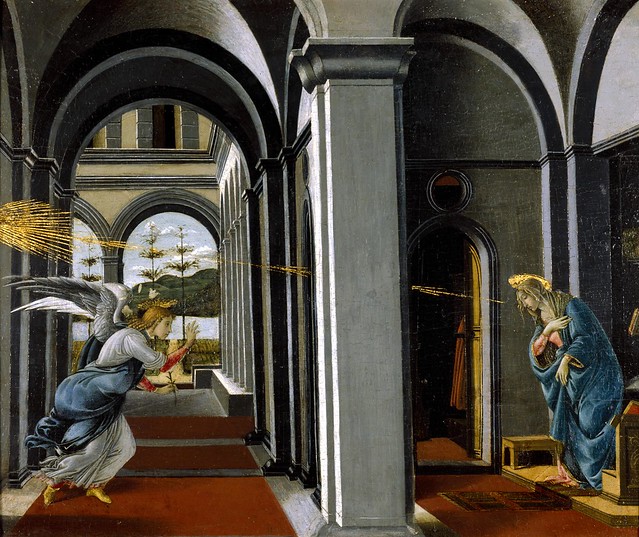
The Annunciation, c. 1490-95
Sandro Botticelli (with assistance?)


Also, on a cultural note: I spent part of my last day in Milwaukee at the Milwaukee Art Museum, where I thoroughly enjoyed a real coffee and “Of Heaven and Earth,” a visiting exhibit of Italian painting from Glasgow museums. I went specifically to see the pieces from the Middle Ages…

P.S. I hope I didn’t spell any names incorrectly... there are so many in this post and I’m still so tired!

P.P.S. I spent this afternoon at my local library for a screening of the documentary Russia’s Open Book: Writing in the Age of Putin, with the film’s co-directors, Sarah Wallis and Paul Mitchell. You can watch it, too, on YouTube. Even if you won’t be able to ask the directors questions, you’ll still get Stephen Fry’s readings of excerpts from several novels—set to wonderful animated segments—as well as interviews with writers including Zakhar Prilepin and Lyudmila Ulitskaya. The very last minute or two, with Vladimir Sorokin, jolted me yet again, even on my third or fourth viewing.
Up Next: Big Book Award winners on Tuesday. And then books galore, probably starting with Viktor Remizov’s Ashes and Dust, a very worthy Big Book finalist about poachers and corruption in the taiga.

Disclaimers: The usual. I collaborated on a story that will appear in an upcoming NYRB book.