- Aleksandr Bushkovsky for his Праздник лишних орлов (The Festival of Superfluous Eagles is how Yasnaya Polyana translated the title and, well, I’m just going to roll with that given that I haven’t read the book), a collection of stories about friends who fought together in Chechnya but can’t figure out what to do with themselves upon returning home. I’ve seen the Russian word for “eagles” used for distinguished soldiers and since these guys feel lost, “superfluous” feels like it refers back to the superfluous man.
- Olga Slavnikova for her Прыжок в длину (Long Jump), a book I find rather heavy with metaphors. Even so, I can understand Vladislav Otroshenko’s enthusiasm for the book given its real plot (the novel does just keep plugging along) and view of the world. I’ve read more than half and plan to finish it for my Big Book reading. Long Jump won the Book of the Year award while I was in Moscow, too.
- Maria Stepanova for Памяти памяти (I’ll go for In Memory of Memory since I haven’t read it yet), which is on the way in English, too. Like the Slavnikova book, In Memory of Memory is also a Big Book finalist.
Sunday, September 16, 2018
Moscow Trip Report 1: Award News, Head Cold Edition
Posted by
Lisa C. Hayden
at
6:14 PM
2
comments
Labels: Aleksandr Solzhenitsyn, fedor tyutchev, Lev Tolstoy, Olga Slavnikova, Read Russia Prize, Vladimir Sharov, Yasnaya Polyana Awards
Saturday, June 4, 2011
BookExpo America 2011: Odds & Ends on Russian Books & Programs
I always seem to enjoy BookExpo America, but this year’s BEA was particularly fun thanks to increased interest in Russian literature: Russia will be the Global Market Forum country in 2012. A brief summary of a press conference about Global Market Forum, posted by BEA director Steve Rosato, mentions plans to bring more than 40 Russian writers to New York. Needless to say, I can’t wait!
This year’s BEA program included two Russian programs that covered, among other things, a bilingual reading from 2017 with Olga Slavnikova and Marian Schwartz, who translated the book for Overlook, plus an introduction to four writers – Irina Bogatyreva, Polina Kliukina, Pavel Kostin, and Andrei Kuzechkin – who were Debut Prize winners or nominees. Kostin and Kuzechkin’s Rooftop Anesthesia and Mendeleev Rock, respectively, were published, in Andrew Bromfield’s translation, by Glas in 2011, and three of Kliukina’s stories, in Anne O. Fisher’s translation, are in the Squaring the Circle anthology, also from Glas.
2011 releases of newly translated Russian books from American publishers include, listed by publication date:
Twelve Who Don’t Agree, by Valery Panyushkin, translated by Marian Schwartz, due out July 16, from Europa Editions. For a taste of Panyushkin, try the recent New York Times piece “Was It Something I Wrote?” I’m looking forward to reading Twelve.
Apricot Jam, a story collection by Aleksandr Solzhenitsyn, translated by ? (I’ll see if I can get the name and add it), due out in September, from Counterpoint. (PDF catalogue) Since Counterpoint’s description refers to the eight stories, written in the 1990s, as “paired,” I’m figuring they’ve preserved (no pun intended) the Apricot Jam story cycle presented in this Azbuka-klassika Russian edition and a book on my shelf.
Thirst, a novel by Andrei Gelasimov, translated by Marian Schwartz, due out November 22, , from Amazon Crossing. I read and enjoyed Thirst years ago, before I started blogging, and was interested to see that Amazon Crossing will be publishing several other Gelasimov books.
The Letter Killers Club, by Sigizmund Krzhizhanovsky, translated by Joanne Turnbull, due out December 6, from New York Review Books. This is a great incentive for me to finally read some Krzhizhanovsky. NYRB also has more Vasily Grossman and Andrey Platonov on the way, in the more distant future.
I’ll be writing more about these books later this year. [Edit: A previous post covers other translation releases for 2011.]
One other note: I finished out my four days in New York with an unexpected visit to the Chelsea Art Museum for a fantastic exhibit: Concerning the Spiritual Tradition in Russian Art: Selections from the Kolodzei Art Foundation. I spent several hours at the museum with Tatiana and Natalia Kolodzei, who gave me a personal tour of the exhibit. If you’re in the New York area, I highly recommend a visit. The exhibit closes June 11; Natalia will offer a gallery talk on June 11 at 4 p.m.
That’s it for today. I’ll be back tomorrow with a brief post on the winner of the NatsBest.
Up Next: The 2011 NatsBest winner, then Vsevolod Benigsen’s ГенАцид (GenAcide). I’m looking forward to getting back to my usual reading pace after a spring of colds and wonderful but exhausting travel.
Disclaimers: The usual. I’ve discussed translated fiction with all the publishers named in this post.
Posted by
Lisa C. Hayden
at
7:11 PM
4
comments
Labels: Aleksandr Solzhenitsyn, Andrei Gelasimov, available in translation(s), book fairs, literary translation, Olga Slavnikova, Sigizmund Krzhizhanovsky
Thursday, November 12, 2009
Favorite Russian Writers A to Я: Erofeev and Esenin
I’ve been struggling over the small pool of letter “E” writers for a some time, hoping more contenders for favorites would emerge from some foggy compartment of my reading memory. Увы, alas, nothing, though there are some worthy writers:

Posted by
Lisa C. Hayden
at
4:14 PM
22
comments
Labels: Aleksandr Solzhenitsyn, contemporary fiction, Mikhail Elizarov, Sergei Esenin, Venedikt Erofeev, Viktor Erofeev
Thursday, September 10, 2009
News Roundup: Survey Says, Awards, and Gulag
1. Survey Says: Master and Margarita! Please don’t ask me about survey methodology… but OpenSpace.ru reported earlier this week that the research center of the SuperJobs.ru portal polled 3,000 Russians and found that their favorite book was Mikhail Bulgakov’s Master and Margarita. Sixteen percent voted for M&M. Respondents were allowed to name several books.
Posted by
Lisa C. Hayden
at
1:44 PM
5
comments
Labels: Aleksandr Solzhenitsyn, awards, Mikhail Bulgakov, Rasskazy, Roman Senchin
Tuesday, November 25, 2008
The 2008 Big Book Winner...
Vladimir Makanin won the 2008 Big Book (Большая книга award today for Асан (Asan), a novel about the Chechen war. I’d been eying Asan on my favorite Russian book site so just ordered it up. I’ve enjoyed Makanin’s writing since the first sentence I read, in which a giant hand swoops down to catch, if only temporarily, a man as he walks down the street.
Second prize went to Liudmila Saraskina for her biography Aleksandr Solzhenitsyn, and third prize was awarded to Rustam Rakhmatullin for Две Москвы, или Метафизика столицы (Two Moscows or the Metaphysics of the Capital)
A posthumous jury prize went to Aleksandr Solzhenitsyn.
Rakhmatullin and Saraskina also won readers’ choice awards, along with Vladimir Kostin, for his collection Годовые кольца (Growth Rings).
I included summaries of Big Book finalists in this previous entry.
Good night!
Further information in Russian:
“Триумвират достойных” – about the winners, particularly Makanin.
“Книжное казино” – Echo of Moscow Russian radio show from November 23, 2008, with Big Book finalists Pavel Basinskii and Margarita Khemlin.
Posted by
Lisa C. Hayden
at
8:57 PM
0
comments
Labels: Aleksandr Solzhenitsyn, Big Book Awards, contemporary fiction, post-Soviet fiction, Vladimir Makanin
Wednesday, October 15, 2008
Back to (Modern) Classics: Solzhenitsyn's "One Day"
The Writer: Aleksandr Solzhenitsyn (Alexander Solzhenitsyn)
Work and Date: Один день Ивана Денисовича (One Day in the Life of Ivan Denisovich) (1959). The book’s Russian title would be translated literally as One Day of Ivan Denisovich.
Why it’s important: The literary journal Новый мир (Novyi mir or New World) published One Day in 1962, during the Khrushchev-era thaw, providing readers with a fictionalized account of one day in the bleak life of a political prisoner in a Soviet camp.
Online criticism, analysis, and background: Harrison Salisbury’s 1963 review from The New York Times. Sheila Fitzpatrick’s “Like a Thunderbolt” is a London Review of Books piece about Liudmila Saraskina’s Aleksandr Solzhenitsyn; Fitzpatrick includes background on the publishing of One Day and the nonpublishing of other works. Michael Scammell’s “Solzhenitsyn the Stylist,” from the New York Times Book Review, is a brief but helpful piece.
IMHO: I first read One Day about 20 years ago, in English translation. Rereading it this fall in Russian was a completely different experience. I’d remembered simple language, but the original is a complicated blend that incorporates dialect and accents, curses, and camp slang.
Since I was already familiar with what happened during Ivan Denisovich Shukhov’s day and have read many other accounts of prison camps, what struck me most during my rereading was how Solzhenitsyn varied his language to create atmosphere. The central portion, for example, when Ivan Denisovich works as a member of a brigade, seems to contain many passages with choppy writing and lots of exclamation marks, highlighting the fast pace of lunch and work, both of which warm Ivan Denisovich.
Back in the barracks, when Shukhov returns from work, Solzhenitsyn’s language feels stylistically simpler, calmer. There is less dialect, sentences seem longer, and my impression is that exclamation marks become sparser. This was my favorite part of the book: the more relaxed style truly reflected the content, as the men waited in line for packages, went for their evening meal, submitted to two evening headcounts, and conversed.
Although I gained a new appreciation for how Solzhenitsyn wrote and structured One Day, I still can’t say it’s a personal favorite. It’s a very, very good book, and I have tremendous respect for Solzhenitsyn’s ability to describe so much, so humanly, so almost-perfectly, in so few words. I have occasionally heard Russians praise One Day but downplay its importance a bit because it shows a relatively easy day in a prison camp – solitary confinement cells, for example, are only mentioned, not observed. To my mind, Solzhenitsyn simply chose to focus on one side of camp life, writing a publishable book and showing, very successfully, how prisoners can maintain their dignity despite the system’s constant humiliations.
I can’t honestly tell you why I’ve never felt enthusiastic about One Day. Perhaps it’s because I read and enjoyed Solzhenitsyn’s full-length novel, В круге первом (The First Circle), first. The First Circle and Раковый корпус (Cancer Ward) both have plenty of space for extended metaphors that specialized settings – a prison camp for scientists and a hospital, respectively – can spawn. Another thought: unless Dostoevsky is the author, I generally prefer long, messy novels to short, neat books or stories… though there are short stories, like Pushkin’s “Пиковая дама” (“The Queen of Spades”) or Gogol’s “Шинель” (“The Overcoat”), that I love every time.
I’ll leave you with two motifs from One Day that I particularly liked. Solzhenitsyn makes nice use of two recurring symbols in One Day: the sun and the moon, representing the passage of time. They also seem to refer to universality and separation since everyone, whether inside or outside the camp, sees the same sun and moon. Still, I think the saddest line in the book is when Ivan Denisovich wonders whether or not he wants to be free again.
Summary: One Day in the Life of Ivan Denisovich focuses on a Soviet political prisoner’s workday, incorporating bits of material that tell of his life and family. The book is neatly structured and provides glimpses into the freedoms and limitations of a prison camp and Soviet life. It is an excellent introduction to fiction about Soviet prison and political “crimes,” and I particularly recommend it to readers who either don’t like long novels or have difficulty keeping track of Russian names.
Posted by
Lisa C. Hayden
at
8:13 PM
0
comments
Labels: Aleksandr Solzhenitsyn, available in translation(s), novellas, Soviet era, thaw era
Sunday, August 31, 2008
Anna K. (Again) & Solzhenitsyn's Style
It’s a lazy, long weekend in this household, but here are quick links to a couple items in this week’s New York Times Book Review…
-Irina Reyn’s What Happened to Anna K., reviewed in the “Fiction Chronicle” column by Jeff Turrentine, sounds like an interesting cross-cultural novel about a Russian émigré, Anna, who regrets her decision to marry a wealthy Russian man.
Irina Reyn on Amazon
Alexander Solzhenitsyn on Amazon
Posted by
Lisa C. Hayden
at
5:23 PM
0
comments
Labels: Aleksandr Solzhenitsyn, contemporary fiction, Irina Reyn
Saturday, August 16, 2008
News Roundup: Mandelshtam, Solzhenitsyn, and Rasputin
This week’s Russian news included several items involving writers:
A monument to poet Osip Mandel’shtam will be unveiled in Voronezh on October 2, 2008, opposite the house where Mandel’shtam lived during his 1934-1937 exile.
A fitting 1935 poem from Mandel'shtam's “Voronezh Notebooks”:
“Пусти меня, отдай меня, Воронеж:”
“O, let me go, Voronezh, O return me”
Two news stories mentioned posthumous honors for Aleksandr Solzhenitsyn. “Большая книга” (“Big Book”) will make a special award to Solzhenitsyn for honor and merit (“честь и достойнство”). The award recognizes, among other qualities, the writer’s ability to remain true to himself and his beliefs. In other news, the Moscow street “Большая Коммунистическая” (“Big Communist Street”) will be renamed for Solzhenitsyn.
On to the slightly weird... When I first saw a headline saying that Valentin Rasputin was going to look at Lake Baikal from the “Mir,” I wondered if a journalist had forgotten that the Mir space station came down to earth in, ah, 2001. No! On Thursday, Rasputin took part in an underwater expedition in a deepwater vehicle that’s also called Mir, which means both “peace” and “world.” Rasputin is known for his activism for protecting Baikal as well as a nationalist bent, which some call “Siberian nationalism.”
One report says Rasputin spent three hours underwater, descending 800 meters. Rasputin told reporters that the underwater world includes beauty, order, friendliness, and a complete absence of aggression. “Yes, the lowest organisms dwell there, but they are somehow higher than us,” he said (my translation).
Posted by
Lisa C. Hayden
at
1:52 PM
0
comments
Labels: Aleksandr Solzhenitsyn, Big Book Awards, Osip Mandel'shtam, Valentin Rasputin
Monday, August 4, 2008
Aleksandr Solzhenitsyn
“Почти счастливый” (“Almost Happy”) is how the Russian news site lenta.ru titled a commentary about the death of Aleksandr Solzhenitsyn. The phrase “almost happy” turns up at the end of Один день Ивана Денисовича (One Day in the Life of Ivan Denisovich):
“Прошёл день, ничем не омрачённый, почти счастливый.”
“The day had passed, undarkened by anything, almost happy.”
Reading Michael T. Kaufman’s lengthy and balanced New York Times obituary of Solzhenitsyn reminded me of episodes I’d forgotten from Solzhenitsyn’s life: the hermit-like Cavendish years, the train trip across Russia, the spousal drama. I’d forgotten his crankiness, probably because I’ve focused for years on what I admire most: Solzhenitsyn’s willingness to ignore consequences and speak out against the Soviet regime.
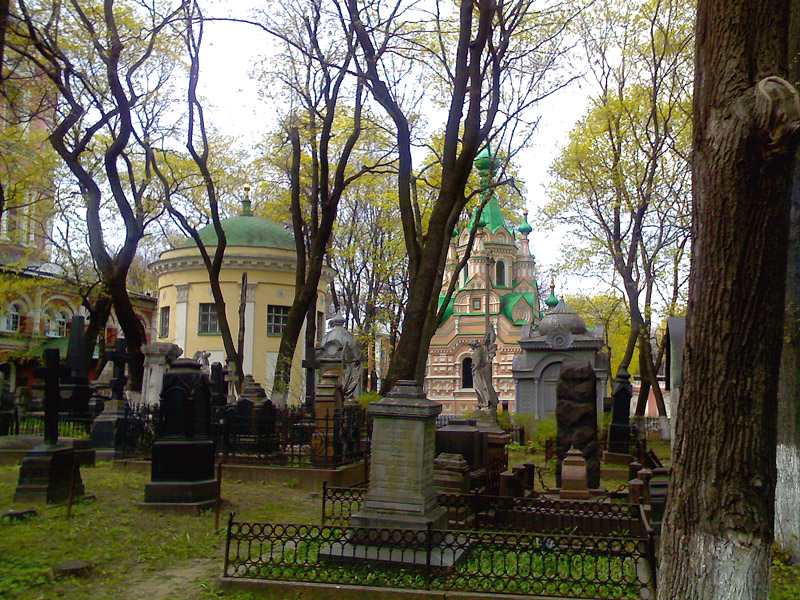
I also admire much of his fiction, particularly Раковый корпус (Cancer Ward), my favorite, thus far, of Solzhenitsyn’s works… though Ivan Denisovich has stood on my “To Read” shelf for months, awaiting a rereading. One book is compact, the other baggy, but both take place in enclosed places and address what it means to live and be human. In death, Solzhenitsyn will rest at Donskoi Monastery in Moscow. Donskoi Monastery and its cemetery were always modest, not a destination of dozens of tour buses, like Novodevichii Monastery and its famous graveyard. I lived near Donskoi Monastery during my first year in Moscow, and sometimes went to sweep old leaves off the grave of Mikhail Kheraskov, an eighteenth-century writer I studied in grad school.I always think of those days when I hear these lines from Aleksandr Gorodnitskii’s song “В Донском монастыре,” (“At the Donskoi Monastery”). Now when I hear them, my thoughts will broaden to remember Solzhenitsyn’s writings and imagine his grave, too, in a place I used to visit.
“Листопад в монастыре. (“The fall of leaves at the monastery.)Вот и осень, - здравствуй. (Here’s autumn – Hello.)
Спит в Донском монастыре (Sleeps at Donskoi Monastery)
Русское дворянство.” (The Russian nobility.”)
Posted by
Lisa C. Hayden
at
1:32 PM
3
comments
Labels: Aleksandr Solzhenitsyn, Soviet era