Sunday, May 15, 2016
Translation Potpourri for a Sleepy Sunday
What better for a blustery Sunday afternoon than a translation
potpourri? And so: two novels written in English, one essay, one short course,
and a link…
I’ll start with Alison Anderson’s The Summer
Guest since it’s a novel with
a Russian theme: a modern-day British publisher, Katya, hires Ana to translate a
journal written by Zinaida Lintvaryova, a young doctor whose own illness has
blinded her. The title’s summer guest is none other than Anton Chekhov, who visits
the Lintvaryov estate in Sumy, in eastern
Ukraine. The journal, which begins in 1888, makes up the bulk of the novel but
Anderson intersperses occasional chapters set in the 2010s, chronicling Katya’s
personal and professional problems—her husband’s absences and their publishing
house’s difficulties—as well as Ana’s work on the manuscript. Of course I relate
heavily to Ana, who can be observed checking spellings, splurging on books, and hoping
for a new project (did Chekhov really leave behind a draft of the novel he read
to Zinaida? could she translate it?), not to mention making an impulsive trip
to Ukraine toward the end of the book. Anderson’s greatest success in The Summer Guest, though, is Zinaida’s
journal, which beautifully meshes Chekhov’s gentlemanly humor and humanity with
Zinaida’s fears and hopes. The rapport he and Zinaida develop is poignant, and
the scene where the Chekhov brothers take Zinaida out in a rowboat is
particularly lovely: Zinaida feels freed, “suspended” from her darkness. Though
the framing device in The Summer Guest
felt a bit thin to me because I wanted to see Katya and Ana in greater depth, and
some of the current events mentioned felt a little tacked on, I’ll simply say (to
avoid spoilers!) that the frame allows Anderson to make the journal count twice.
More important to me, as a reader and recommender, though, is the readability
of the journal’s story, the colorfulness of the Chekhov and Lintvaryov families,
and the many admirable choices that Anderson makes when incorporating bits of
Russian language and background into her text. Her own translation work informs
her well; so, apparently did her research, which she notes in a brief
but informative afterword…
Which made me especially happy to read Anderson’s “Spurn the Translator at Your Own Peril,” on The
Millions. I won’t say much about it because you can read it yourself, here. (I
know at least one of you already read it: thanks to the reader who sent the
link!) Anderson writes about reader perceptions of translation, translator and
author invisibility (she takes a fun angle on this because of the mysterious
Elena Ferrante), what is (ahem!) found in translation, and even how we do it. She
mentions two to ten pages a day. And yes, of course she’s right that “it is a
pleasure.” She’s also right that translators make “interesting protagonists
within the fiction that is their province”: she notes novels including Rabih
Alameddine’s An Unnecessary Woman,
which I was lukewarm on, and Idra Novey’s Ways
to Disappear…
I loved Idra Novey’s Ways
to Disappear. She had me with her first sentence: “In a crumbling
park in the crumbling back end of Copacabana, a woman stopped under an almond
tree with a suitcase and a cigar.” Whether it was the repetition of “crumbling,”
the combination of the suitcase and the cigar, or the thought of almonds, which
I enjoy eating on just about anything, yes, dear reader, I bought the book. In
hardcover. I had to find out what happens when American translator Emma Neufeld
goes from snowy Pittsburg to blazing-hot Brazil in search of the almond tree woman,
Beatriz Yagoda, who happens to be Emma’s author. Beatriz has gone missing because
of gambling debts and Emma goes missing on her lets-go-running-and-lets-get-married
boyfriend because, well, our authors are part of us in some mysterious way. Has
Novey ever used the hairbrush of one of her authors? I don’t know and I don’t
need to know but I will say that I, personally, have never used a hairbrush (or
comb or other grooming device) belonging to any of my authors but oh my, what a
wonderful, fitting metaphor. On the same page (23, if anyone’s looking), there’s
a mention of Emma’s (earlier, of course) confession to Beatriz that she “hadn’t
been quite as dutiful in her last translation as in Beatriz’s earlier books,
and Beatriz had replied that duty was for clergy. For translation to be an art,
she told Emma, you have to make the uncomfortable but necessary transgressions
that an artist makes.” Yes, yes, and yes. I couldn’t wait to buy
the book because Novey mentions “the risk-taking, the reckless joys
of translation” in an LA
Times interview that my cousin clipped and sent to me… Risks and joys
are what make translation so exhilarating and I feel lots of reckless joy and risk-taking
in Ways to Disappear, too, and all of
it works and pays off for Novey. For more complete views: Heller McAlpin’s review
on npr.org or Catherine Lacey’s review
for the New York Times Book Review.
If you’re a translator looking for a short course in London,
in mid-July, you might consider Translate
in the City, where the tutor for Russian is Robert Chandler. I think I
first heard about the program from Anne Marie Jackson, an alumna of the very
first “Translate in the City” course: among other things, Anne Marie is a
co-translator of two volumes of Teffi that were just released (herewith, the 2016
translation list for details), including Memories: From Moscow to the Black Sea, reviewed
in today’s New York Times Book Review by
Masha Gessen. Translate in the City covers eleven languages and all are taught
by instructors whose main work is literary translation. Robert notes that many students
come to London from the US for the program.
And, finally, to end on an especially happy and
translation-related note, here’s an article by Alison Flood for The Guardian: Translated
fiction sells better in the UK than English fiction, research finds. And here's a Monday-morning addition, also in The Guardian: Daniel Hahn's The Man Booker International prize: a celebration of translation.
Disclaimers: The usual.
Thank you to HarperCollins for the review copy of The Summer Guest. The book has a release date of May 24, 2016. Especially
recommended for Chekhov fans.
Up Next: Eugene Vodolazkin’s The Aviator, which I
just plain loved. Alexander Snegirev’s Vera, which I may yet call Faith.
Maria Galina’s Autochthons, which is getting eerier… The Big Book finalist
announcement is coming up soon, too.
Posted by
Lisa C. Hayden
at
5:34 PM
4
comments
Labels: Anton Chekhov, literary translation, novels, translation
Sunday, May 8, 2016
New Russian-to-English Translations for 2016
I’m happy to say that compiling lists of Russian-to-English
translations continues to be a big job! The list for 2016 contains about three
dozen titles—roughly the same as in 2015—and there’s a blend of genres again
this year, too, with plenty of poetry, fiction, and nonfiction. There’s also an
interesting combination of contemporary and classic literature. As I mentioned
in 2014,
grant programs from the Institute
of Translation and the Prokhorov Fund’s
Transcript Program contribute tremendously, both directly and indirectly,
to publisher interest in Russian-to-English translations. I know that I’m not the
only translator who’s tremendously grateful to both organizations for all they
do to support publishers, translators, and writers.
A few caveats, as always. This list is just a start—I’ll be adding
books throughout the year and making corrections, as necessary. Please e-mail me with any changes; my
address is on the sidebar. As last year, this is a global list that
includes new translations and retranslations. I’ve linked titles on the list to
publishers’ pages wherever possible. Publication dates are notoriously subject
to slippage; I transfer books from year to year as necessary and have crossed
out titles on the 2015
list that weren’t actually published in 2015. Update: I have done the same for 2016 titles that were moved to 2017. I’ll place a link to this
post on the sidebar of the blog for easy reference. I’m taking names and titles
for 2017 now, so please feel free to send them in. Finally, don’t forget the Self-Published
Translation post: If you have a book to add, please add it in a comment on
that page.
As always, happy reading!
Alexievich, Svetlana: Chernobyl Prayer, translated by Anna
Gunin and Arch Tait; Penguin Modern Classics, out now.
Alexievich, Svetlana: Second-Hand Time,
translated by Bela Shayevich; Fitzcarraldo Editions (UK) and Random House (US), May 2016.
Aristov, Vladimir: What
We Saw from This Mountain, translated by Julia Trubikhina (Kunina),
Betsy Hulick, Gerald Janecek; Ugly Duckling Presse, spring 2016.
Babel, Isaac: Odessa
Stories, translated by Boris Dralyuk; Pushkin Press, November 2016.
Belenkaya, Nadezhda: Wake in Winter, translated by Andrea Gregovich, Amazon Crossing, November 2016.
Bulgakov, Mikhail: The White
Guard, translated by Roger Cockrell; Alma Classics, August 2016.
Chekhov, Anton: Little
Apples and Other Early Stories, translated by Peter Constantine; Steven
Stories Press, January 2016.
Dostoevsky, Fyodor: The Double,
translated by Hugh Aplin; Alma Classics, August 2016.
Gazdanov, Gaido: The Flight, translated by Bryan Karetnyk; Pushkin Press, March
2016.
Gelasimov, Andrei: Cold, translated by Marian Schwartz; Amazon Crossing, 2016.
Grigorieva, Lydia: Shards
from the Polar Ice: Selected Poems; translated by John Farndon with Olga Nakston; Glagoslav,
August 2016.
Gromova, Natalia: Moscow in the 1930s: A Novel from the
Archives; translated by Christopher Culver, Glagoslav, May 2016.
Ivanov, Georgy: Disintegration
of the Atom/Petersburg Winters, translated by Jerome Katsell and
Stanislav Shvabrin; Academic Studies Press, April 2016.
Kashin, Oleg: Fardwar, Russia!, translated by Will
Evans; Restless Books, January 2016.
Klekh, Igor: Adventures in the Slavic Kitchen, translated
by Michael Naydan and Slava Yastremski; Glagoslav, 2016. (A food book, what a
rarity!)
Kobrin, Kirill: Eleven Prague Corpses, translated by Veronika Lakotova; Dalkey Archive Press, 2016.
Krzhizhanovsky, Sigizmund: The Return of Munchausen, translated by Joanne Turnbull; NYRB Classics, December 2016.
Kurkov, Andrei: The Bickford Fuse, translated by
Boris Dralyuk; MacLehose Press, May 2016.
Lebedev, Sergei: Oblivion, translated
by Nina W. Bouis; New Vessel Press, January 2016. This one’s on the shelf; I’ll
be reading it soon.
Lermontov, Mikhail: A Hero of Our Time, translated by Elizabeth Cheresh Allen; Northwestern University Press, August 2016. An old favorite in what is apparently a new translation; I just love this book (previous post).
Levental, Vadim: Masha
Regina, translated by Lisa Hayden; Oneworld Publications, May 10, 2016.
(previous
post)
Lukyanenko, Sergei: Sixth Watch, translated by Andrew Bromfield; Harper Paperbacks (US)/William Heinemann (UK), August 31/September 1 respectively.
Mandelstam, Osip: Voronezh Notebooks, translated by
Andrew Davis; New York Review Books, 2016.
Mayakovsky, Vladimir: Vladimir Mayakovsky and Other Poems, translated by James Womack; Carcanet Press, October 2016.
Nemzer, Anna: Prisoner,
translated by Ronan Quinn; Glagoslav, February 2016.
Osminkin, Roman: Not a Word About Politics, translated by Olga Bulatova, Cement Collective, Jason Cieply, Ian Dreiblatt, Brian Droitcour, Keith Gessen, Ainsley Morse and Bela Shayevich, Anastasiya Osipova, Jon Platt, and David Riff; Cicada Press, May 2016. Double your fun: it's bilingual!
Platonov, Andrei: Fourteen
Little Red Huts and Other Plays, translated by Robert Chandler,
Jesse Irwin, and Susan Larsen; Columbia University Press/Russian Library,
December 2016. Edited by Robert Chandler.
Pushkin, Alexander: Yevgeny Onegin, translated by Anthony Briggs; Pushkin Press,
April 2016.
Pushkin, Alexander: Novels, Tales, Journeys: The Complete Prose of Alexander Pushkin, translated by Richard Pevear and Larissa Volokhonsky; Knopf, November 2016.
Shklovsky, Viktor: Viktor
Shklovsky, A Reader, translated by Alexandra Berlina; Bloomsbury Publishing,
December 2016.
Sinyavsky, Andrei: Strolls
with Pushkin, translated by (the simplified version!) Catharine
Theimer Nepomnyashchy, Slava I. Yastremski, and Michael Naydan, with Olha Tytarenko;
Columbia University Press/Russian Library, December 2016.
Sokolov, Sasha: Between
Dog and Wolf, translated by Alexander Boguslawski; Columbia University
Press/Russian Library, December 2016.
Stratanovsky, Sergey: Muddy
River: Selected Poems, translated by J. Kates; Carcanet Press Ltd., May
1, 2016.
Strugatsky, Arkady and Strugatsky, Boris: The Doomed City, translated by
Andrew Bromfield; Chicago Review Press, July 2016.
Teffi: Rasputin and Other Ironies,
translated by Rose France, Robert Chandler, and Anne Marie Jackson; Pushkin
Press, May 2016. This book is known as Tolstoy, Rasputin, Others, and Me: The Best
of Teffi for the NYRB Classics edition also scheduled for May 2016.
Teffi: Memories: From Moscow to the Black Sea,
translated by Robert Chandler and Elizabeth Chandler, Anne Marie Jackson, and Irina Steinberg; Pushkin
Press, May 2016. Same title for
the NYRB Classics edition, also due in May 2016.
Tsvetaeva, Marina: Letter to the Amazon, translated by A'Dora Phillips, Gaëlle Cogan; Ugly Duckling Presse, spring 2016. With an introduction by Catherine Ciepiela.
Ulitskaya, Ludmila: The Kukotsky Enigma, translated by Diane Nemec Ignashev; Northwestern University Press, August 2016. Ulitskaya’s Russian Booker winner.
Vagner, Yana: To the Lake, translated by Maria Wiltshire; Skyscraper Publications, fall 2016.
Various: 1917:
Literature from the Russian Revolution, ed. Boris Dralyuk, translated by
Boris Dralyuk et al; Pushkin Press, December 2016. I’m very happy to say that I
translated a story by Mikhail Prishvin for this anthology!
Various: Written
in the Dark: Five Siege Poets, translated by Anand Dibble, Ben
Felker-Quinn, Ainsley Morse, Charles Swank, and Jason Wagner; Ugly Duckling
Presse, Spring 2016. Poets are Gennady Gor, Dmitry Maksimov, Sergey Rudakov,
Vladimir Sterligov, and Pavel Zaltsman, edited by Polina Barskova.
Various: A Very Russian Christmas: New Vessel Press, October 2016. There's a Zoshchenko story on the New Vessel Web site, here.
Various: 100 Poems About Moscow: An Anthology, translated by various translators, compiled by A. Skortsov; BGS-press, 2016. A bilingual edition that many friends and colleagues were involved with.
And this Mongolian poetry collection, just because I feel
like mentioning it:
Oidov, Tseveendorjin: The End of the Dark
Era, translated by Simon Wickhamsmith; Phoneme Media, July 2016. The
book also includes Oidov’s artwork.
Disclaimers: The usual.
Up
Next: Eugene Vodolazkin’s The
Aviator, which I just plain loved. Alexander Snegirev’s Vera, which
I may yet call Faith. Maria Galina’s Autochthons…
Posted by
Lisa C. Hayden
at
5:24 PM
17
comments
Saturday, April 30, 2016
2016 National Bestseller Award Short List & The Penguin Book of Russian Poetry
The National Bestseller Award announced its short list this week. Here’s
the list of five finalists—one short of the usual six—with the number of points
each was awarded in the first round of voting. Comments on the finalists and the process,
written by Vadim Levental, the NatsBest secretary, are online, as are jury
members’ reviews and votes.
- Leonid Yuzefovich’s Зимняя дорога (excerpt 1) (2) (3) (Winter Road) (12 points). I’ve been looking forward to Winter Road—which describes itself as a documentary novel—ever since it arrived at my house a month or so ago: I feel like I can’t go wrong with the combination of “documentary” and “novel” as well as, of course, Yuzefovich, Civil War figures, and Yakutia, a place I once spent several very wintery days.
- El’dar Sattarov’s Транзит Сайгон-Алматы (literally Transit Saigon-Almaty) (9 points). Sattarov’s apparently a fairly unknown writer from Kazakhstan: the book looks at the history of Vietnam during 1930 through the 1990s, apparently through the story of a partisan.
- Aglaya Toporova’s Украина трех революций (excerpt 1) (2) (3) (very literally Ukraine of Three Revolutions) (8 points). Levental notes Toporova’s “centrist position” and “calm ironic intonation” in describing events in Ukraine in recent years.
- Maria Galina’s Автохтоны (part 1) (part 2) (Autochthons, I guess) (7 points). Autochthons sounds like a Galina-esque combination of phantasmagoria, magical realism, history, and a regular-guy hero. I’ll be starting on this one soon, too.
- Mikhail Odnobibl’s Очередь ([The?] Line) (5 points). Even Levental calls this one mysterious; he also describes the book as “Kafkaesque fantasy.” Beyond that, it’s unclear who Odnobibl really is. (An all-too-quick-because-it’s-a-sunny-day search for descriptions popped this piece, which I may take a better look at when the sky’s cloudier.)
Levental also mentions notable authors who missed the short
list… picking up many of the same names I did: he praises Alexander Snegirev’s collection
of short stories (which Snegirev sent to me and which looks very good), and Anna
Matveeva’s novel but said he breathed a sigh of relief that Petr Aleshkovsky
and Anatoly Kim missed out. I, too, was surprised that Andrei Astvatsaturov and
Dmitrii Danilov received only one point each.
The NatsBest winner will be announced on June 5.
Bonus: A Rambling, Non-Scholarly,
and Occasionally Gushy Translated Book Note. I finally (finally!) ordered
up a copy of The Penguin Book of Russian
Poetry, edited by Robert Chandler,
Boris Dralyuk, and Irina Mashinki, and containing translations by the editors plus
a stellar list of several dozen additional translators, beginning,
alphabetically, with Alexandra Berlina and ending with Katherine Young. I
bought the anthology for what might be called “business with pleasure” reasons:
for one thing, Russian novels often contain lines from well-known Russian
poetry, transforming anthologies into reference books for me. For another, I
like anthologies with introductory notes about authors and this book’s notes,
written by Chandler and Dralyuk, are lively and informative. I also feel a special
connection to the book after hearing related translator readings and conference
presentations in June 2013 (previous
posts).
Though I’ve only puttered with the book a little since I
bought it on Tuesday—flipping to random pages and poets as I’m wont to do with
collections like this and floating off on happy little tangents—I did take a closer
look at one poem, Velimir Khlebnikov’s “Заклятие смехом,” which Christopher
Reid’s “after Khlebnikov” interpretation renders as “Laugh Chant.” And which I
liked very much because it tied my tongue and made me laugh, just like the original
does when I read it aloud. I zaumed in on “Laugh Chant” thanks to Amateur
Reader (Tom), who blogs at Wuthering Expectations, and who happens to be on a
Russian poetry tear that’s included a recent post
about The King of Time: Selected Writingsof the Russian Futurian, a 1985
volume with poems translated by Paul Schmidt. Although the beginning of Schmidt’s
version of Khlebnikov’s laughter poem didn’t catch my feel for the poem like
Reid’s does, the beautiful incantatory effect of Schmidt’s neologisms, rhyme,
and even shifted hyphens (!) in a chunk of Khlebnikov’s play-that's-more-than-a-play, Zangezi, that appears in the Penguin collection
bewitched me completely. Zangezi, by
the way, was performed in the late 1980s; read about it in The New York Times, here.
For a comparison of these same two versions of the laughter poem (as well as mentions of other humorous
poems) see Alice E.M. Underwood’s Russian
Life article, here.
Disclaimers: The usual
as well as warm collegial/professional/personal relations with the editors of
the Penguin book and many of the translators therein. I’ve translated excerpts of
books by Galina as well as Vadim Levental’s entire novel Masha
Regina, which is just out from Oneworld Publications and has even been
spotted in the wild at McNally Jackson Books in New York City!
Up Next: Eugene Vodolazkin’s The Aviator, which I just
plain loved. Alexander Snegirev’s Vera, which I may yet call Faith.
Translations due out in 2016—send in those entries!
Posted by
Lisa C. Hayden
at
7:15 PM
5
comments
Labels: contemporary fiction, Leonid Yuzefovich, literary translation, Maria Galina, National Bestseller, poetry, Velimir Khlebnikov
Sunday, April 24, 2016
The 2016 Big Book Award Long List
The Big Book Award announced its long list on
Wednesday and, yes, I was delusional in thinking I’d blog about it during the
week: the most I accomplished before the weekend was placing orders for a few of
the books! The list of finalists will be announced by the end of May. Here are
some of the books on the long list, in alphabetical order within my categories:
Books I’ve already read:
- Yuri Buida’s Цейлон (Ceylon) (previous post), which combines the personal and the historical in a fairly balanced, disciplined novel about a family.
- Evgeny (Eugene) Vodolazkin’s Авиатор (The Aviator), which I finished the other night and loved for its blend of genres, epochs, and themes, some familiar from Laurus and Solovyov and Larionov.
Books already on the shelf or on order; I’ve read other
books by all but one of these authors:
- Vasily Avchenko’s Кристалл в прозрачной оправе (excerpt) (Crystal in a Transparent Frame), which describes itself as “stories about water and rocks” and focuses on Vladivostok. Shortlisted for last year’s NatsBest; quite possibly destined for beach reading, given the coastal theme.
- Pyotr Aleshkovsky’s Крепость The Citadel, which I bought after reading the beginning of the PDF that Aleshkovsky’s literary agency sent me: archaeology and medieval constructions caught me.
- Aleksandr Arkhangelsky’s Правило муравчика. Сказка про бога, котов и собак (excerpt) (The Purrer Rule. A Tale About God, Cats, and Dogs (a terribly troublesome title, thanks to the word I’ve rendered here, for now, as “purrer,” which Arkhangelsky says plays on the Russian term for the right-hand rule, which I didn’t know existed in either language, and “mur,” which is purr.)), which I’m a little skeptical about because I don’t often do well with fables and parables. But Arkhangelsky clearly knows cats.
- Maria Galina’s Автохтоны (part 1) (part 2) (Autochthons, I guess), which sounds like a Galina-esque combination of phantasmagoria, magical realism, history, and a regular-guy hero.
- Dmitry Danilov’s Есть вещи поважнее футбола (There Are Things A Little More Important Than Football/Soccer), which I bet I can read now that I have new glasses! Danilov is one of the only authors I’d trust to keep me reading a book about soccer. (This is already shaping up to be quite a season: ocean, cats, soccer…)
- Aleksei Ivanov’s Ненастье (Foul Weather), which is apparently about an Afghan War veteran who robs an armored car. I enjoyed Ivanov’s Geographer (previous post) and a couple of my Goodreads friends seemed to love this book… (I hope I do, too, since it’s 638 pages!)
- Igor Savyelev’s Вверх на малиновом козле (Upwards, in a Puce Vehicle; the cover illustrates this pretty nicely and you can see the vehicle is a Jeep-like vehicle, one that has all sorts of slangy nicknames, like the goat in the title), involving a young lawyer going to Abkhazia for his wedding. I’ve enjoyed reading Savelyev in the past and, well, another wedding novel set in the Caucasus sounds natural after reading Alisa Ganieva’s Bride and Groom (previous post).
- Ludmila Ulitskaya’s Лестница Якова (Jacob’s Ladder), a family saga set during 1911-2011; I read the beginning after Ulitskaya’s agent sent me the text.
- Leonid Yuzefovich’s Зимняя дорога, (The Winter Road), which is described as a “documentary novel”: the cover sums up the details with “General A.N. Pepeliaev and anarchist I.Ia. Strod in Yakutia. 1922-1923.”
Here are some others that sound especially interesting for various reasons:
- Sergei Kuznetsov’s Калейдоскоп (excerpt) (Kaleidoscope), dozens of characters and their stories, set in the twentieth century; one of my Goodreads friends just started it and said she was enjoying it, noting sex and vampires.
- Boris Minaev’s Мягкая ткань (Soft Fabric; these links only lead to the first book, Batiste, within what must be a planned multiple-volume novel/series…), which I know nothing about other than that it’s set around the beginning of World War 1 and a friend (real-life, this time) absolutely loved it.
- Sasha Okun’s Камов и Каминка (Kamov and Kaminka), which purports to involve art and a detective story; titled for two artists.
- Valerii Khazin’s Прямой эфир (Live Broadcast) is intriguing because the cover makes it look like a romance novel and the description says it’s a detective/adventure novel about a man running from terrorists… but Alexander Gritsman, writing for Interpoezia, focuses largely on its poetic aspects. (I admit I made a very superficial skim of his piece: I don’t want to spoil the book for myself with details.)
- There are also several books about writers that I’ll list without titles: Aleksei Varlamov on Vasily Shukshin; Zakhar Prilepin on Anatoly Mariengof, Boris Kornilov, and Vladimir Lugovskoi; and Dmitrii Bykov on Vladimir Mayakovsky (submitted as a manuscript and listed as such on the Big Book site).
I could go on and on (and on) about the other half of the
list but will stop there pending announcement of the finalists next month.
Disclaimers: I’m a member of the Big Book’s jury,
the Literary Academy, and will vote on finalists later this year. Authors and
literary agents have given me electronic copies of several of these books.
Up Next: The National Bestseller Award’s
short list. Vodolazkin’s The
Aviator,
which truly does soar. Alexander Snegirev’s Vera, which I may yet call Faith. Translations coming out in
2016—send in those entries!
Posted by
Lisa C. Hayden
at
4:01 PM
2
comments
Labels: awards, Big Book, Big Book 2016 finalists
Sunday, April 10, 2016
Akunin’s Black City
A bit of backstory: the beginning of Akunin’s novel was
first published in Le Figaro, which
in 2008 solicited a series of stories celebrating Homer. Apparently all
the pieces Le Figaro published in the
series begin with that line, which also happens to begin the fourteenth book of
The Odyssey. Caveat: since I haven’t read
The Odyssey (ouch!), I’m not sure
what other elements Akunin may have borrowed. I can say that Akunin’s Odysseus
is, initially, in Yalta in 1914. So is Fandorin, on a Chekhov-related mission. Odysseus
commits murder and absconds to Baku meaning, of course, that Fandorin goes to
Azerbaijan, too, both to hunt down Odysseus and to deliver trunk of clothes to
his wife, the actress known as Klara Lunnaya, who’s making a film in Baku. Phew.
Well. Well. I’ve
long had a sentimental soft spot for Akunin’s Fandorin novels because it was the
unexpected gift of a Fandorin Book, Любовница смерти (known as She Lover of Death in Andrew
Bromfield’s translation), that got me reading contemporary Russian fiction a
decade or so ago. But, as I’ve
noted before, my interest in Akunin’s Fandorin series dropped off rather
sharply after He Lover of Death—the
ninth book in the Fandorin franchise: I wasn’t even able to finish all four
that came after that—and more than one Russian reader has suggested to me that
Akunin исписалcя, wrote himself out, after He Lover of Death.
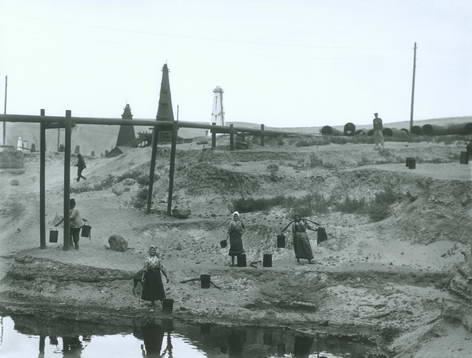
| Pipeline, Black City, 1905 |
Will the loony Klara and Fandorin (who clearly disdains her
and recognizes her use of her stage characters’ speeches in real life) stay
together despite her cinematic suitor? Will Fandorin and his local sidekick
Gasym, who mangles Russian grammar, catch the bad guys? Will the merry petroleum
widow whose eunuch servant serves as a fixer (and voyeur, too: I think this bit
player is one of the book’s most interesting characters) for her assignations
set her eye on Erast Petrovich and lure him to her home? And, since someone
somewhere referred to The Black City as
containing alternative history: will the world erupt in war after the events in
Sarajevo? I’ll never tell. All in all, I think I got more enjoyment from
surfing for background on turn-of-the-last-century Baku and looking
at old online photographs than reading The
Black City, which lacks pep and pop, and feels all too much like a franchise
novel.
Up Next: Eugene
Vodolazkin’s Aviator and Alexander
Snegirev’s Vera, both of which I’m
enjoying, in very different ways. The Big Book longlist is coming soon, too. Also:
translations due out in 2016. Translators and publishers, please let me know
what you have scheduled for release this year!
Photograph by Carl Bulla (who sounds like
a pretty interesting character himself!), via Wikipedia.
Posted by
Lisa C. Hayden
at
6:24 PM
5
comments
Labels: Boris Akunin, contemporary fiction, detective novels
Subscribe to:
Posts (Atom)