Sunday, August 31, 2008

Anna K. (Again) & Solzhenitsyn's Style

It’s a lazy, long weekend in this household, but here are quick links to a couple items in this week’s New York Times Book Review

-Irina Reyn’s What Happened to Anna K., reviewed in the “Fiction Chronicle” column by Jeff Turrentine, sounds like an interesting cross-cultural novel about a Russian émigré, Anna, who regrets her decision to marry a wealthy Russian man.

-This week’s essay, “Solzhenitsyn the Stylist,” by Michael Scammell, examines Aleksandr Solzhenitsyn’s writing style. Scammell concludes: “In remembering Solzhenitsyn, I would hate to lose sight of the irreverent, even playful, outsider and versatile stylist who preceded the solemn historian and gloomy prophet.” Scammell includes mentions of One Day in the Life of Ivan Denisovich, “Zakhar-the-Pouch,” and The Gulag Archipelago.

Irina Reyn on Amazon
Alexander Solzhenitsyn on Amazon

Saturday, August 30, 2008

World War 2, Life, Fate, and Spiritual Entropy

I’m sure my experience reading Vasilii (Vasily) Grossman’s Жизнь и судьба (Life and Fate) differs significantly from the experiences of other readers: Life and Fate is so long and complex that I suspect most people, particularly first-time readers, come away with messages that reflect the portions of the book they relate to most.

This 900-page epic about the World War 2 era in the USSR was unpublishable when Grossman attempted to submit it in the early 1960s. It did not reach Soviet readers until perestroika. Life and Fate includes dozens of characters, military and civilian, free and imprisoned, Soviet and German, and Grossman draws dangerous parallels between two oppressive systems. Many characters fight for the city of Stalingrad. Others are physicists. Others are held in the Lubyanka prison or German concentration camps.

Sometimes Life and Fate felt so sprawling or crowded that I thought Grossman should have written several novels instead of trying to force all his people and ideas into one book. But there is a nucleus: the Jewish physicist Viktor Shtrum, who struggles with “spiritual entropy” as Soviet science and society become increasingly politicized. Viktor and his wife Liudmila connect, with various degrees of separation, to most of the novel’s other characters through family ties.

Although I wish my Russian edition of the novel had contained a list of characters and settings, as the English translation evidently provides, I found that relaxing and accepting my commitment to read – and enjoy! – Life and Fate through the Russian Reading Challenge worked at least as well. Rather than obsessing over all the character names and traits, I focused on the people and subplots that interested me most.

There is plenty to choose from. Most passages in Life and Fate describe events in the lives of characters, but Grossman also includes an essay on war. A few chapters lack characters and feel more like journalistic pieces, reflecting Grossman’s background as a war reporter. Grossman’s writing style is generally straightforward and simple, though he occasionally hits what felt to me like off notes with gratuitous references to, for example, Avogadro’s number and certain works of Russian literature.

Life and Fate is often compared with War and Peace, and these long, loose books have obvious formal similarities. But what struck me more was the authors’ common emphasis on individuals: Grossman, for example, focuses on humanity by looking at the individuals who make up the Soviet and German military... and those who become victims of the Soviet GULag and German concentration camps.

This theme leads to the book’s best scenes, some of the most moving I’ve read in years: a letter from a doomed woman to her son (Part 1, chapter 18), an account of being led to death in a gas chamber (Part 2, chapters 45-50), and a scene of encircled German troops at Christmas (Part 3, chapter 36-37). I recommend these scenes highly to all readers, whether or not they read the entire book.

Shtrum’s spiritual entropy and intense loneliness as he struggles with his own moral decisions and fate as a theoretical scientist left an overwhelming impression, too. Observing the effects of fear, acceptance, and relief on his actions was not easy – these sections centering around the egocentric Shtrum were both emotional and a little drawn-out – but I added more depth to my readings of the psychology of professional and personal survival during the Stalin era.

My overall feelings about Life and Fate are mixed: in spite of some beautifully composed scenes and interesting characters, the hundreds of chapters don’t always quite hold together, and some characters inevitably felt a little stereotypical or unnuanced.

Despite its minor imperfections – which are hardly surprising for a novel of the bulk and scope of Life and Fate – Grossman’s descriptions felt so immediate that I often had trouble putting the book down to cook dinner or go to sleep. And I enjoyed considering the many painful ideas the book presented, particularly the politicization of the Soviet military and society, and the accompanying moral dilemmas for people who wanted to be good citizens but think for themselves, even during wartime.

Life and Fate deserves respect, attention, and readers. It addresses questions of freedom, morals, and politics that – as recent news shows – still burn today. If you decide to read Life and Fate, I suggest finding an edition with a list of characters… and then choosing a few people or plot lines to specialize in if the book threatens to overwhelm you. It’s worth the time and the effort, and you may, as I do, feel that you’ll want to read it again some day so you can learn more.

Summary: I highly recommend Life and Fate to readers interested in totalitarianism, the World War 2 era in the Soviet Union, and moral decisions. Although the novel sometimes feels overloaded with places and characters, some of whom flit in and out of the narrative, I appreciate the care with which Grossman describes people and their situations.

For further reading:

Robert Chandlers’s introduction to his translation of Life and Fate

Review of Life and Fate in London Review of Books

“Under Siege,” by Keith Gessen, from The New Yorker

Life and Fate on Wikipedia (includes summaries)

Short stories translated by Andrew Glikin-Guskinsky, winner of the 2007 Pushkin Poetry Prize for Translation, are available on Sovlit.com: “The Resident” “In the Country” “A Tale About Happiness” “In the War”

“In the Main Line of Attack” is anonymously translated nonfiction, by Grossman, about Stalingrad.

Life and Fate on Amazon.com

(Cross-posted on
Russian Reading Challenge.)

Saturday, August 16, 2008

News Roundup: Mandelshtam, Solzhenitsyn, and Rasputin

This week’s Russian news included several items involving writers:

A monument to poet Osip Mandel’shtam will be unveiled in Voronezh on October 2, 2008, opposite the house where Mandel’shtam lived during his 1934-1937 exile.

A fitting 1935 poem from Mandel'shtam's “Voronezh Notebooks”:

“Пусти меня, отдай меня, Воронеж:”

“O, let me go, Voronezh, O return me”

Two news stories mentioned posthumous honors for Aleksandr Solzhenitsyn. “Большая книга” (“Big Book”) will make a special award to Solzhenitsyn for honor and merit (“честь и достойнство”). The award recognizes, among other qualities, the writer’s ability to remain true to himself and his beliefs. In other news, the Moscow street “Большая Коммунистическая” (“Big Communist Street”) will be renamed for Solzhenitsyn.

On to the slightly weird... When I first saw a headline saying that Valentin Rasputin was going to look at Lake Baikal from the “Mir,” I wondered if a journalist had forgotten that the Mir space station came down to earth in, ah, 2001. No! On Thursday, Rasputin took part in an underwater expedition in a deepwater vehicle that’s also called Mir, which means both “peace” and “world.” Rasputin is known for his activism for protecting Baikal as well as a nationalist bent, which some call “Siberian nationalism.”

One report says Rasputin spent three hours underwater, descending 800 meters. Rasputin told reporters that the underwater world includes beauty, order, friendliness, and a complete absence of aggression. “Yes, the lowest organisms dwell there, but they are somehow higher than us,” he said (my translation).

Monday, August 4, 2008

Aleksandr Solzhenitsyn

Почти счастливый” (“Almost Happy”) is how the Russian news site lenta.ru titled a commentary about the death of Aleksandr Solzhenitsyn. The phrase “almost happy” turns up at the end of Один день Ивана Денисовича (One Day in the Life of Ivan Denisovich):

“Прошёл день, ничем не омрачённый, почти счастливый.”

“The day had passed, undarkened by anything, almost happy.”

Reading Michael T. Kaufman’s lengthy and balanced New York Times obituary of Solzhenitsyn reminded me of episodes I’d forgotten from Solzhenitsyn’s life: the hermit-like Cavendish years, the train trip across Russia, the spousal drama. I’d forgotten his crankiness, probably because I’ve focused for years on what I admire most: Solzhenitsyn’s willingness to ignore consequences and speak out against the Soviet regime.

I also admire much of his fiction, particularly Раковый корпус (Cancer Ward), my favorite, thus far, of Solzhenitsyn’s works… though Ivan Denisovich has stood on my “To Read” shelf for months, awaiting a rereading. One book is compact, the other baggy, but both take place in enclosed places and address what it means to live and be human.

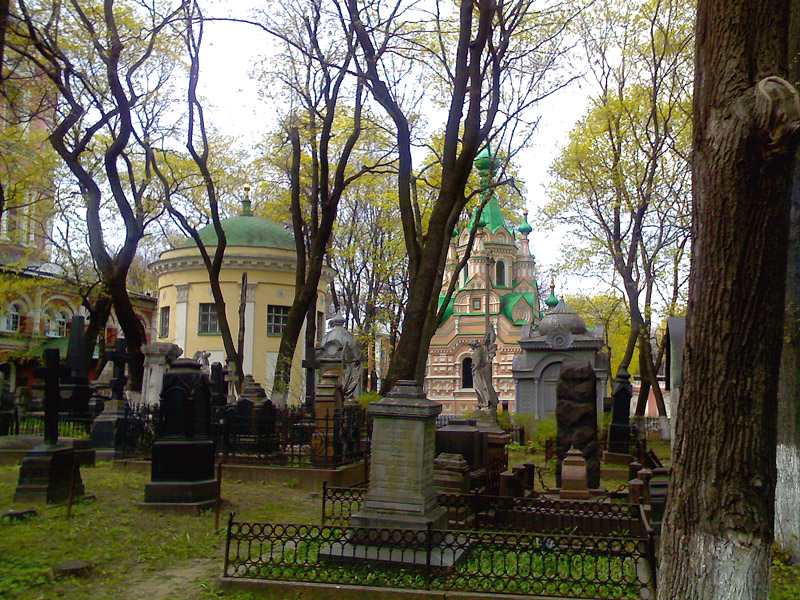
In death, Solzhenitsyn will rest at Donskoi Monastery in Moscow. Donskoi Monastery and its cemetery were always modest, not a destination of dozens of tour buses, like Novodevichii Monastery and its famous graveyard. I lived near Donskoi Monastery during my first year in Moscow, and sometimes went to sweep old leaves off the grave of Mikhail Kheraskov, an eighteenth-century writer I studied in grad school.

I always think of those days when I hear these lines from Aleksandr Gorodnitskii’s song В Донском монастыре,” (“At the Donskoi Monastery”). Now when I hear them, my thoughts will broaden to remember Solzhenitsyn’s writings and imagine his grave, too, in a place I used to visit.

“Листопад в монастыре. (“The fall of leaves at the monastery.)
Вот и осень,
- здравствуй. (Here’s autumn – Hello.)
Спит в Донском монастыре (
Sleeps at Donskoi Monastery)
Русское дворянство.” (The Russian nobility.”)


Monday, July 28, 2008

Russian Reading Challenge 2: Platonov's “Foundation Pit”

Andrei Platonov’s Котлован (The Foundation Pit) was a perfect Russian Reading Challenge selection: I read the first 30 pages several years ago but got stuck. I’m glad I stuck with it this time because, though I still found it quite difficult, this short novel is very rewarding.

The Foundation Pit, written in 1929-1930, is an allegory of the era of collectivization: workers digging a pit for a foundation also find themselves digging, in effect, a collective grave. They take part in the collectivization campaign, too, banishing kulaks by sending them away by raft.

Form and content are inseparable in The Foundation Pit, and Platonov draws on language and themes found in divergent genres, mixing elements of folk tales, carnival, existentialism, and socialist realism to create a dystopia so painful and surreal that I feel almost as if I’ve lived there.

Despite the inherent tragedy of The Foundation Pit, some passages were laugh-out-loud absurd – the behavior of collectivized horses stands out – but I thought others plodded, perhaps because they were so familiar and reminiscent of “real” socialist realism. Other chunks of text jarred to good effect: an orphaned girl taken in by the workers speaks in violent, revolutionary terms, demanding death of kulaks.

What sets The Foundation Pit apart from other dystopian novels – and most other fiction – is Platonov’s creativity with the Russian language. Language is the foundation upon which the book is built, with Platonov’s diversity of linguistic registers reflecting changes in society. The Foundation Pit depicts on every level – from words to characters’ actions – untenable visions of a socialist future in a place where truth and rationality are losing their meaning.

Joseph Brodsky says in this (Russian) piece, which evidently appears as an afterward to an English-language edition of The Foundation Pit, that the book is untranslatable. (I find a lot of irony there!) He cites as one reason Platonov’s depiction of a nation that effectively becomes a victim of its own language. Obviously not all of Platonov’s words in The Foundation Pit have equivalents in a language like English – the content of “энтузиаст,” for example, differs tremendously on a cultural level from our “enthusiast.”

But I think Brodsky may underestimate the talents of translators, readers, and Platonov himself. Many of Platonov’s unique phrases translate elegantly enough into English to read well. Robert Chandler and Geoffrey Smith’s translation beautifully captures the mood and meanings of the novella’s unique first paragraph. Much later in the book, as I translate it, a bear “sang a song with his jaw.” Even culturally laden phrases that don’t translate this easily into English can still display Platonov’s ability to use repetition or word combinations that force the reader to (re)consider meaning.

Even if I don’t quite agree with Brodsky about translating Platonov – particularly after reading Robert Chandler’s crackling versions of Platonov in The New Yorker and the paragraph cited above – I think his definition of surrealism sums up The Foundation Pit very neatly. He calls Platonov the first surrealist, arguing that surrealism is not an aesthetic category but rather (as I translate it) “a form of philosophical rage, a product of the psychology of dead end.”

In the end (whether it’s dead or not) what I find most interesting about The Foundation Pit is that, to be blunt, I didn’t often enjoy reading it… but I can’t stop thinking about it. I even have thoughts of rereading it. I’ve enjoyed Platonov’s short stories much more because they feel peculiar and, perhaps even alienated, without conveying utter desolation. But I love a literary puzzle, and that’s what The Foundation Pit feels like. I may be back in a few years.

Summary: The Foundation Pit is one of the most difficult books I’ve read in recent years, but it’s worth the effort if you enjoy dystopia or writing that depends on both form and content to convey its messages. Platonov layers the book with far more themes than I’ve mentioned here: I felt like I barely touched on their significance in this, my first reading. I should add that my first attempt at reading The Foundation Pit was my introduction to Platonov. Reading several short stories between then and now helped me feel more comfortable with his style.

Cross-posted at Russian Reading Challenge