Showing posts with label Soviet era. Show all posts

Sunday, May 11, 2014

Baldaev and Vasiliev’s Soviets


SOVIETS coverEvery now and then—maybe once a year or so—I read a book that gives me a fleeting case of PhD program dropout remorse syndrome. I like, no, I love, the book, see its value for a broader readership, and begin designing courses and creating syllabi in my head so I can force (okay, attempt to force…) a group of unsuspecting but curious undergraduates to read, appreciate, and love it, too. “Fleeting” means the syndrome usually disappears within a few minutes, after I’ve remembered how much I hate grading, office hours nobody comes to, and academic paperwork. Besides, I have a completely painless outlet for some of those urges: some of you occasionally ask me for book ideas for your courses.

I’m sure you can see where this is going: I read Soviets by Danzig Baldaev and Sergei Vasiliev and would love to put it on someone’s reading list. Soviets is my second book from Fuel, a London-based publisher. The first was Baldaev’s Drawings from the Gulag, which I called “a deeply disturbing book that documents, through detailed drawings and concise captions, the horrors of the Soviet Gulag system.” Soviets isn’t nearly as disturbing, though many of Baldaev’s dozens of angry caricatures and commentaries on life in Sovietdom are uncomfortable and grotesque, addressing subjects like anti-Semitism, alcoholism, and the Afghan War. Soviets juxtaposes Baldaev’s work with photos by Sergei Vasiliev, a photographer who worked for Vecherny Chelyabinsk. Like Drawings, Soviets is bilingual (this is great for students!), with English-language translations from Polly Gannon and Ast A. Moore.

Soviets covers so much that it’s hard to summarize its value for students of Soviet-era or post-Soviet Russian literature and culture. For someone like me, a life-long learner in the field who lived for an extended period in 1990s Russia, (and admittedly has trouble making it through book-length nonfiction), the broad range of figures in Baldaev’s drawings and Vasiliev’s photos—the former draws everyone from a barfing drunk to a medal-covered Brezhnev, and the latter photographs everyone from soldiers meeting Yuri Gagarin to female prisoners “volunteering” on their day off—goes a long way toward filling in gaps on aspects of Soviet life that I never had a chance to witness or learn about. Things like scientists sorting vegetables in a storage facility or the name Нихухрымухрыниксы (transliterated: Nikhukhrymukhryniksy, which the book calls “a portmanteau of ne khukhry-mukhry (‘not to be sniffed at’) and the Kukryniksy – three satirical cartoonists who signed their work collectively under this name.” Kukryniksy drawings were published in the Soviet magazine Krokodil. “The fifth column,” a term that’s making a comeback these days, also appears in Soviets.

I should add that many of the panels in Soviets include explanatory notes. Randomly opening—this was a fortuitous opening to a particularly rich panel—brings up a page depicting tiny people being emptied into a Belomorkanal cigarette carton by the NKVD and an ashtray bearing the saying “Лес рубят – щепки летят” and holding what looks to be a heap of people. This page includes a reference to poet Osip Mandelstam with a brief note about his life, work, arrest, and death plus a note about Belomorkanal cigarettes, created to commemorate the construction of the canal between the White and Baltic Seas. The saying on the ashtray, by the way, is rendered as “You can’t make an omelette without breaking eggs,” which is certainly more familiar and, thus, clearer to casual readers than something more literal, like “If you cut down trees/forests, sawdust flies,” something I’d never really thought much about until sawdust really did fly in my backyard last week on a breezy day.

Many pages of Soviets also contain quotations from works about the Soviet Union that complement the topic in the drawing. The book endeared itself to me even more when I found a quote from The Soviet Union: empire, nation, and system, by Aron Katsenelinboigen, whose course in Soviet geography taught me more about the Soviet system than all my other college courses combined. He’s quoted on a page about alcohol, workers, and payment, noting that workers were sometimes compensated in pure alcohol, measured by the glass. The bibliography in Soviets contains around 30 items. From a to z, they start with Martin Amis’s Koba the Dread and end with Aleksandr Zinovyev’s Homo-Sovieticus.

And then there are Vasiliev’s photos, all black and white, many depicting official parades, sporting events, and workers. They make a beautiful complement to Baldaev’s drawings, particularly because it’s often difficult to decide which angle on Soviet reality feels more realistic. Or absurd. I’m sure part of the reason the spectral double-paged picture of a long, long line for Lenin’s mausoleum on a snowy day particularly struck me: I went to the mausoleum in 1983 and was nearly denied entry because I was wearing sandals. Disrespectfully open sandals. There’s also the contrast of an tubercular inmate who has a Lenin tattoo on his shoulder, and, later in the book, five nude sunbathing women on a roof in Chelyabinsk in 1976. The shadows are lovely. The ethereal photo across from that one shows a woman bathing her son in a small washtub on a roof; it looks like there’s a clothesline, too, and a breeze. It’s 1977.

The Fuel Web site offers some sample pages from Soviets, here. The photographs include the afore-mentioned photo of the line to Lenin’s mausoleum.

Disclaimers: The usual. Thank you very, very much to Fuel for sending me a review copy of Soviets.

Up Next: Yuri Mamleyev’s The Sublimes. Later still, Mikhail Bulgakov’s White Guard, which I like very, very much but find slow going. Also, Irina Ratushinskaya’s The Odessans. And a trip report on BookExpo America, which is coming up at the end of the month and will feature a day-long program about translated literature.

Monday, October 10, 2011

Totally: Novellas by Chukovskaya and Iskander

I first read Lydia Chukovskaya’s Софья Петровна (Sofia Petrovna) in the early ‘90s, when I lived in Moscow: it was one of six pieces in a collection called Трудные повести (Difficult Novellas) that also included Andrei Platonov’s Котлован (The Foundation Pit). My reading skills weren’t ready for Platonov then but I could read and appreciate Sofia Petrovna quickly, easily, without a dictionary. The novella was even more satisfying because I could tell Chukovskaya’s direct, unembellished language was the perfect medium for a story about a Leningrad widow whose son Kolya, an engineer, is arrested in the 1930s.

I appreciated Sofia Petrovna even more this time around, watching Chukovskaya unwind the story of Sofia Petrovna, a loyal Soviet citizen who becomes more and more unhinged trying to handle difficulties at work and the cruelly impossible task of finding her son. Chukovskaya experienced similar humiliations—she wrote the novella during November 1939-February 1940, after the arrest of her husband, which makes it even more remarkable—and demonstrates the effects of totalitarianism with painfully striking precision.

I’m thinking of totalitarianism in the second definition in my Webster’s New [sic: it’s dated 1981] Collegiate Dictionary—“the political concept that the citizen should be totally subject to an absolute state authority”—more than the first definition’s “centralized control by an autocratic authority” that creates the political concept. Chukovskaya’s novella is less about the system itself than its effects on the thinking and actions of regular people, represented by a circle of family and friends anchored by Sofia Petrovna. The book draws the reader into her psyche as Soviet life wears her down.

We hear Sofia Petrovna’s doubts about Kolya’s activity and friendships, experience her pain when her communal apartment neighbors say nasty things, and feel her deflation when she has brief audiences with government officials after waiting for hours, even days. As the novella continues and we witness her evolution from a happy, optimistic publishing house administrator to a recluse who barely eats, it’s not difficult to understand her confusion, her delusions, or her fears of everybody.

After Chukovskaya’s book I picked up a collection by Fazil’ Iskander and chose Сумрачной юности свет (The Light of Murky Youth) for one reason: at 75 pages, it was the longest piece in the book. I didn’t know the story was about an Abkhaz man, Zaur, whose father was shot during the Stalinist terror. Most of the story takes place when Zaur is an adult—there are mentions of Khrushchev—and the most vivid aspect of the story for me, perhaps because of my lingering thoughts on Sofia Petrovna, was the uneasy balance of private and public in Zaur’s life. That made the story feel like a later generation’s update on totalitarianism.

Iskander gives Zaur a childhood with public Stalin portraits and an adulthood that values privacy and individuality, whether he’s writing to the Central Committee about the need for more private farming or trying to find a place to be alone with his girlfriend. Though Iskander deftly blends believable characters with lots of telling episodes about required volunteer work, sneaking into forbidden places, police behavior, family pressures, and politics, the story felt a little lumpy to me. But that’s a minor complaint, what with the strong pull of the conflict between control and privacy (always a favorite), and Iskander’s ability to, like Chukovskaya, create vivid scenes, portraits, and stories out of simple words and complex human situations.

Level for Non-Native Readers of Russian: Though I think the language in Sofia Petrovna is easier than the language in The Light of Murky Youth, I’d recommend both to readers looking for relatively easy novellas.

Up Next: Perhaps Mikhail Lipskerov’s Белая горячка. Delirium Tremens, which I began reading today at the beach. If I don’t like the book as reading material it may still have an honored place in my life and beach bag: it’s a paperback of the perfect size and thickness for killing the stinging beach flies that love to hover around my ankles.


Fazil Iskander on Amazon
Sofia Petrovna on Amazon

(I am an Amazon associate and receive a small percentage of purchases that readers make after clicking through my links.)

Tuesday, September 22, 2009

Red Star and Bunin Prize Finalists

Some unconnected bits of news:

1. Sunday’s New York Times Book Review ran a short piece describing David King’s 350-page Red Star Over Russia: A Visual History of the Soviet Union From the Revolution to the Death of Stalin. (Link here) The online version of the review, which also covers other books, includes a slide show with a photo of Stalin, lying in state, amid flowers and fronds. Writes reviewer Steven Heller, “What a relief it must have been for so many to see him in such a tableau.”

2. The Bunin Prize people named a short [?] list of 15 finalists. This year the award covers books of commentary. (full list in Russian) The nominees include two writers also known for their fiction: Zakhar Prilepin and Aleksandr Prokhanov. Both have won the National Bestseller award. Prokhanov’s winning book, Господин Гексоген (Mister Hexogen) is on my to-read shelf.

The Bunin nominee that interests me most is literary critic Lev Danilkin’s Нумерация с хвоста. Путеводитель по русской литературе (Numbering from the Tail. A Guidebook to Russian Literature. The title refers to the conventions of numbering cars on passenger trains.). A brief excerpt is available on ozon.ru, here. I’ve enjoyed Danilkin’s writings on contemporary fiction ever since I read his analysis of Boris Akunin’s Fandorin novels, using the short novel Декоратор (The Decorator) as a defining moment. (in Russian here)

3. Also, before I forget, The Complete Review posted a very favorable review (here) of Il’f and Petrov’s Золотой телёнок (The Golden Calf), which is due out soon in a new translation. (previous post) I’m enjoying my Il’f&Petrov-fest: somewhere I noticed a reader’s comment that The Twelve Chairs acts like an anti-depressant, so it makes a sunny change of pace after Makanin’s Underground!

Photo from Jazza, via stock.xchng

Monday, May 25, 2009

Catching Up: Two Novellas, One Novel

Leonid Leonov’s Конец мелкого человека (The End of a Petty Man) has a heck of a first line:

Поздним вечером одной зимы, когда, после долгих и бесплодных поисков какой-нибудь пищи, тащился он домой бесцельно, встречен был им неожиданный человек с лошадиной головой под мышкой.

Late in the evening one winter, when he was dragging himself home aimlessly after long and fruitless searches for some kind of food, he ran across an unexpected person with a horse head under his arm.

Of course it’s the horse head that got me. As an optimist, I thought the unexpected person was leading a horse in a strange way, but The End is a novella about the early 1920s in the USSR, when food and firewood were scarce. Horse heads end up on the table – food for transitional epochs, one character says – and kind guests bring firewood when they visit. Fedor Andreich, the story’s main character, by the way, scares the horse head right out from under the other man’s arm then takes it.

Fedor Andreich is a professor writing about the Mesozoic Era… leading to all sorts of mentions of caves, ice, and even dinosaurs. Of course Fedor Andreich is something of a soon-to-be-extinct dinosaur himself, a superfluous man for his time who’s so unpleasant he even forgets his dying sister.

The End of a Petty Man is a strange, almost hallucinatory story that also includes an alter ego of sorts, a “ферт” (fert) that visits Fedor Andreich. “Fert” can mean either the name of the Russian letter Ф (f) or a fop. Or both, I think: Fedor begins with F, after all, and he is rather vain. The story conjures up images and themes from an almost endless stream of predecessors, including 19th-century fiction with doubles, devils, and mental health, as well as more contemporaneous stories, notably Evgenii Zamiatin’s “Пещера” (“The Cave”). There are also Biblical references, including that apocalyptic horse’s head, the Ten Commandments, and a doctor’s office referred to as something of a “sodom,” a chaotic place.

I don’t know if The End of a Petty Man has been translated but I do know it is easier to find Leonov’s work in English translation than in Russian originals. Leonov’s short story “Бродяга” (“The Tramp”) is available online, in English translation, on Sovlit, and there are translated novels for sale on Amazon. If I had to describe in one word what little I’ve read of Leonov’s early work, I’d probably chose “intriguing” or maybe “edgy,” thanks to the feeling I was reading a strange cross between, maybe, Dostoevsky and Platonov or Pilniak. The End was alternately suspenseful and enjoyable, with occasional tedious moments.

“Tedious” describes Филиал (The Foreign Branch), Sergei Dovlatov’s novella about a radio station reporter attending a conference in Los Angeles about the future of Russia. Though some of the flashbacks to the narrator’s (“Dalmatov’s”) early and obsessive love for the treacherous Taisiia feel fairly true, there are too many of them to achieve a good balance with the present-day observations, which lack the acidity of, say, The Compromise. (Previous post: The Compromise) The title’s foreign branch, by the way, refers to the United States, which is seen as a foreign branch for the future Russia. I think Dovlatov writes best – meaning with the sharpest absurdity and humor – about the USSR, not the USA, but that’s a personal preference.

It took months of on-and-off reading to get through Источник счастья (The Source of Happiness), Polina Dashkova’s attempt to cram the Russian revolution, a parasite that gives eternal life (!), a superwealthy Russian businessman, and a pile of family history into one book. I’ve read and enjoyed several Dashkova detective novels but Happiness tries too hard to address too many Big Questions. The attempt to address history and eternity lured Dashkova away from what she writes best: crime novels about the post-Soviet period that describe frayed social fabric and the heroism of ordinary women. These are the books that keep me up at night.

In Russian Pulp, a detailed study of Russian detective novels, Anthony Olcott compares Dashkova with her peers and concludes, “Perhaps the most eloquent explorations of the collapse of the Russian state, however, come in the novels of Polina Dashkova.” Some of Dashkova’s books have been translated into German: look for Polina Daschkowa.

Leonid Leonov on Amazon
Sergei Dovlatov on Amazon
Polina Dashkova on Amazon
Russian Pulp on Amazon

Wednesday, May 6, 2009

Out of Gogol's "Overcoat": Voinovich's "Fur Hat"

Okay. I admit that “Soviet-era satire” probably sounds, to many readers, like a tired, irrelevant genre these days. But Vladimir Voinovich’s Шапка (The Fur Hat) is a wonderful piece of perestroika-era work that combines light, humorous writing with absurdity and serious insights into how we determine self-worth. I say “we” because, despite the Soviet setting and numerous colorful characters, this novella is about all of us.

The Fur Hat concerns a writer, Efim Rakhlin, who avoids political trouble by focusing his novels on “хорошие люди,” good people, decent people, who wind up in ridiculously difficult adventures in remote locations and become heroes. Rakhlin’s research takes him to the exotic reaches of the Soviet Union, where oil industry workers, cave explorers, and other locals reward him with gifts that decorate his apartment. Things like a taxidermied penguin.

Unfortunately, poor Efim is probably not even quite what we think of as a midlist author so, when the Writers’ Union decides to give each member a fur hat, Efim is disappointed with what the union offers him. Writers with far less output than Efim’s 11 books receive far better fur. The low-level gift incenses Efim so much that his search for what he perceives as justice eventually leads to a man-bites-man episode and a not-so-happy ending.

Why is Efim so unhappy about the low-rent hat? I’m sure symbolism has something to do with it: a hat warms the head, the writer’s most valued asset. More concretely, here’s the second part of a sentence about Efim’s thoughts on Chekhov. It provides a sample of Efim’s opinion of himself (translation is mine):

“…но, читая Чехова, он каждый раз приходил к мысли, что ничего особенного в чеховских писаниях нет, и он, Рахлин, пишет не хуже, а, может быть, даже немного лучше.

“…but reading Chekhov, he came to the conclusion every time that there was nothing special in Chekhov’s writings and that he, Rakhlin, writes no worse, and maybe even a little better.”

Readers familiar with Nikolai Gogol’s story “Шинель” (“The Overcoat”) (previous post) probably already hear echoes of Akakii Akakeivich, the impoverished copy clerk who needs a new winter coat. Several scenes in The Fur Hat resurrected Akakii Akakeivich for me, especially one when Efim walks through light, dry snow like an old man, weighted down by his mood and a briefcase full of his own books about good people. Later, when his condition reaches its nadir, he, a writer, also begins copying, albeit in a different way: writing down, verbatim, what people say around him in a meeting.

The Fur Hat is a short, easy, and (dare I say it?) fun book to read with some very enjoyable set pieces and vivid examples of hypocrisy and human ambition. Voinovich weaves in a lot more, including anti-Semitism, funny names, and relations with the West. What I love most about Voinovich’s writing, though, is that he makes it easy for us – yes, that’s you and I – to laugh at ourselves even as we think “Ouch!” when we recognize bits of ourselves in Rakhlin and his colleagues, and begin to question our own behavior.


Monday, April 20, 2009

Two from Terts: “Liubimov” and “Pkhents”

It’s difficult to believe the same person -- Andrei Siniavskii (pseudonym Abram Terts) -- wrote the busy novella Любимов (Liubimov or The Makepeace Experiment) and “Пхенц” (“Pkhents”), a restrained short story. Both pieces contain the science fictionish and/or grotesque elements Terts thought reflected life better than realism but, stylistically, the stories are opposites.

Liubimov reminds me of a pint of ice cream that’s so overloaded with the conflicting flavors of chips, nuts, and other marginally edible stuff that it’s hard to taste the ice cream itself. On the crude plot summary level, Liubimov is a dystopia of sorts concerning a bicycle repairman who leads a small city using hypnotism. In my favorite scene, unprestigious foodstuffs take on luxe flavors: water becomes alcohol, canned red peppers become beef, and cucumbers become sausage.

It’s too bad Terts piled on so many genre elements, literary devices, and tangents – folk tale, religion, unclean forces, footnotes, and on and on – that the story and its underlying questions about truth, lies, and history nearly get lost. With its spirits, inventive language, and fast pace, I can’t argue with the blurb in my book that says Liubimov descended from Gogol, Bulgakov, and Platonov. It has some wonderful material, but it’s a little too antic and crowded for my taste.

Staying with the dessert theme: if “Pkhents” were ice cream, it would be a rich vanilla with a twist of high-quality fudge or peanut butter. I read the story as an afterthought because it followed Liubimov in my book. It’s a beautifully crafted story about someone with a hunchback who lives in Moscow under false documents. I don’t want to say too much and spoil the surprise of the story – I knew what it was and wish I hadn’t – but I will say that the story is very, very touching in showing how loneliness affects us. “Pkhents” is simple and quietly funny, too, with some fantastic остранение (defamiliarization). The story is oddly mesmerizing, and I recommend it very highly.

I would be remiss if I didn’t mention the role these stories played in Terts’s show trial for anti-Soviet agitation and propaganda in 1966. Certain works published in the West -- Liubimov, along with On Socialist Realism and The Trial Begins – underpinned the indictment against Terts. Although “Pkhents” didn’t figure into the indictment, in his closing plea Terts invoked a line from the story about being different. He then commented, in the translation given in Max Hayward’s book On Trial, “Well, I am different. But I do not regard myself as an enemy; I am a Soviet man, and my works are not hostile works.” Terts was tried along with writer Iulii Daniel (Nikolai Arzhak) (previous post on Arzhak). Neither pled guilty. Both were convicted: Terts received a seven-year sentence, and Daniel received five years.


Max Hayward's On Trial
Abram Terts on Amazon

Saturday, January 24, 2009

Selected Short Stories

I had a unusual and strange urge to read short stories last week… I probably needed to work something out of my system before reading War and Peace.

I began with some political stories by Iulii Daniel (a.k.a. Nikolai Arzhak), a dissident writer who, in 1966, was sentenced to five years of hard labor for publishing stories in the West. Daniel was tried together with Andrei Siniavskii (a.k.a. Abram Tertz). Few editions of Daniel’s writing seem to have been published in Russia since perestroika; I was lucky to find one when I lived in Mosow. Daniel’s work is available in English translation.

I began with a reread: “Человек из МИНАПа” (“The Man from MINAP”). The story concerns a man who claims he can determine the gender of his children by thinking special thoughts (I won’t say what) whilst having sex. I have funny memories of reading the story 20 years ago because our teacher censored certain words. When I confronted her with that fact – and the expurgated words, which I found in a library book – in class, she told me I was too curious, “настоящая дочка Евы” (“a true daughter of Eve”). This time around, the story felt most interesting for its picture of how Soviet institutions handled the man’s talents.

Next up was the title story of Daniel/Arzhak’s collection, “Говорит Москва” (“This Is Moscow Speaking”). The story is named for a line used by radio announcers. In this case, the announcer tells listeners about an upcoming “day of open murders,” a special day that the narrator says fits right along with Artillery Day and Day of Soviet Press. As the narrator says: “Транспорт работает, милицию трогать не велено – значит порядок будет.” (“Public transportation works, the police are ordered not to touch – that means there will be order.”) There are lots of funny lines in the story (“provincial Hamletism” sticks with me, too), though I thought Daniel was most effective in showing characters’ reactions to the “holiday” and the larger meaning of the fear it engendered.

“Искупление” (“Atonement”) felt even more dangerous: a rakish narrator, Viktor, is accused of informing on an old acquaintance, resulting in his arrest and a sentence in prison camp. The acquaintance wants Viktor to suffer, too, so orders him to leave town and never marry. This story about guilt – both collective and individual – blends Soviet-era sociopolitical themes with love. The content makes “Atonement” politically treacherous but it also feels artistically risky, thanks to Daniel’s energetic writing style and a harsh ending. I think it succeeds.

For a change of era, I reread the first story in a collection of Anton Chekhov’s works: “Ионыч” (“Ionych”). Though Chekhov’s simple, clear style feels as comfortable as old slippers, his characters made me even more uncomfortable and sad than Daniel’s. We know these people, particularly the title character, a porcine, money-hungry provincial doctor who becomes a “pagan god” whose only joy is a lost love.

Sigh. I love Chekhov’s clarity and clean writing but I’m ready for the happy chaos of War and Peace. 

Yuly Daniel on Amazon

Friday, January 23, 2009

"Oh, Shabbat!" Reads Well on Any Day of the Week

Gefilte fish. I can’t stop thinking about gefilte fish after reading Dina Kalinovskaia’s (Kalinovskaya) novella О суббота! (Oh, Shabbat!).

Oh, Shabbat! is a lovely, little-known book about a visit to Odessa from a prodigal, Grisha, who immigrated to the United States decades ago, leaving behind his family, falling out of touch, and causing some hard feelings. Kalinovskaia had a true ability to capture, in very few pages, the humor and sadness of life when she wrote about meetings and partings, both temporary and permanent.

My favorite scene in Oh, Shabbat! doesn’t sound like much... It takes place at a dinner in Grisha’s honor, a dinner for which a woman named Revekka has made gefilte fish. Revekka’s husband, Saul, is seated next to their grandson’s girlfriend. She doesn’t eat the gefilte fish or the crooked chicken neck she receives later, and Saul realizes the young woman is pregnant. First he tells her he loves bread and, yes, pickles, then he invites her to the kitchen, where he fries potatoes for her.

I could eat fried potatoes every night of the week, so it’s tempting to think that scene got me because of the food, but Saul’s sensitivity is far tastier. I love Kalinovskaia’s many accounts of loving, familial bickering: this is a “you’ll laugh, you’ll cry” kind of book that shows great compassion for people and their shortcomings. This dense little book reads easily, so I already want to reread it, to absorb more of the humor, the Odessan setting and language, and the people themselves.

I am sorry to report that Oh, Shabbat! has not been translated into English. It was originally published in the Soviet journal Дружба народов (Friendship of Peoples) in 1980 and was not reprinted until 2007, in the “Prose of Jewish Life” series from a Moscow publisher, Текст (Text). 

Carp photo courtesy of onemhz, via stock.xchng

Gefilte fish recipes welcome. 

Tuesday, January 13, 2009

The Weight of “Heavy Sand”

Anatolii Rybakov’s Тяжёлый песок (Heavy Sand) is a Russian novel that reads almost like a triptych of novellas. The first third of the book is a pre-revolutionary love story about a Swiss man and a Ukrainian woman. The second segment shows how they raise a large family in a small Soviet-era city. The final portion details how World War 2 destroyed the family and most of the rest of the city’s Jewish population.

Characters and the consistent, homey narrative voice of Boris, one of the couple’s sons, link the three pieces of Heavy Sand. Boris tells their life stories, often interrupting himself to step forward or backward in time. He even occasionally addresses his readers, asking, for example, if we’ve remembered certain characters, are familiar with Jewish traditions, or know historical details about World War 2. Though the voice sometimes feels a little more folksy than I prefer, I was grateful that at least one writer has found a graceful way to gently remind me who is who!

Heavy Sand left me with a mixed impression. The cross-cultural love story felt fairly conventional, partly because the couple, headstrong Rakhil’ and steady Yakov, felt a little stereotypical. In the middle section, some characters appear and feel important, only to disappear after what turn out to be life-like cameo appearances. This piece of the book provides a “lite” version of Stalinist repression that enabled Heavy Sand to be published in a journal during the 1970s: prison camps are not mentioned and the justice system works. Heavy Sand’s picture of the Stalin era contrasts sharply with Rybakov’s later Дети Арбата (Children of the Arbat) trilogy, which even includes Stalin as a character.

Warnings of the war first sneak into Heavy Sand in the person of a Polish refugee who comes to Russia and works with Boris. Rybakov, through Boris, who survives the war through military service, is at his narrative best when he describes how most of the family dies under German occupation. Boris’s voice combines pride and anger, factualness and emotion, creating scenes of unforgettable cruelty. 

As I read the last chapters, I realized the power of the ordinariness of Rybakov’s characters: Boris shows us the remarkableness of good people, some children, some elderly. Though many of the characters seemed rather flat for most of the book, the vividness of their final decisions and actions and, ultimately, their deaths, made them feel very real.

With so much death and brutality, the last third of the book is quick-paced and very emotional. Boris often repeats “вечная память” (“eternal memory”) after eulogizing his family members and neighbors, giving the book’s final pages the feel of a prayer. This Novelguide page mentions several of the religious motifs from Heavy Sand. It also notes the final page, on which, after the war, a partisan asks Boris if the Russian and Hebrew lines on a memorial stone read the same. They do not, though Boris says they do, highlighting differing versions of official history. 

For further reading: 

"Soviet Jews in War: A Searing Account" -- New York Times PDF article (subscribers or paid download), December 26, 1978

Anatoly Rybakov on Amazon

Sunday, November 23, 2008

Post-1917 Top Fiction Hits of Russian Literature: A Very Biased Russian Lit Reading List

Choosing a list of top hits from post-1917 Russian fiction falls into the “herding cats” category. Genuine hits are elusive, thanks to official cultural ideology during the Soviet era. Then there’s the fact that the time period under consideration began less than a century ago, meaning it’s tough to know what will be considered classics in another hundred years.

So... This list includes prose popular among readers (Russian and otherwise) and books that reflect certain tendencies or trends in fiction after 1917. Like them or not, I’ve made sure to include books involving Soviet-era repression, socialist realism, satire, World War 2, and absurdity. Like the Top Ten list of pre-revolutionary books (here), these are the books I’d want to teach in a survey course.

Aleksandr Solzhenitsyn. I wrote about Один день Ивана Денисовича (One Day in the Life of Ivan Denisovich) and its popularity in this previous post. I respect One Day but have always had more affinity for two of Solzhenitsyn’s longer novels: В круге первом (The First Circle) and Раковый корпус (Cancer Ward), which Barack Obama also lists as a favorite. Another thought: Varlam Shalamov’s acclaimed short-short stories, such as Колымские рассказы (Kolyma Tales), are also about prison camps.

Mikhail Bulgakov. Мастер и Маргарита (Master and Margarita) is often referred to as a cult favorite, but I think its popularity is too broad to fit the term. I’ve enjoyed the novel twice, though I admit my indifference (or sleepiness?) in Sunday school means I enjoy the Soviet-era scenes much more than scenes with Pontius Pilate. Others: I am a bigger fan of Bulgakov’s novella Собачье сердце (Heart of a Dog). Bulgakov’s play Иван Васильевич (Ivan Vasilyevich) is a modern classic for its adaptation to film. (Previous post: Mikhail Bulgakov and Ivan Vasilyevich.)

Isaak Babel’. I struggled with Babel’s Конармия (Red Cavalry) when I read it in grad school because of the brutality of certain scenes, so I would probably choose some of Babel’s atmospheric stories about Odessa.

Il’f and Petrov. Двенадцать стульев (The Twelve Chairs) is a classic satirical novel of the early Soviet era that I am ashamed to have never finished, despite beginning and loving it twice… it’s laugh-out-loud funny, and I wonder if maybe I’m afraid to finish it.

Vladimir Voinovich. No list of Soviet-era fiction would be complete without Voinovich’s satirical Private Chonkin books. It seems they’re going out of fashion – they’re very popular among readers my age and older. When I lent them to several readers who are, uhm, considerably younger than I who had never heard of Chonkin, they also loved them.

Boris Pasternak. Doctor Zhivago, about a doctor in early Soviet Russia and the consequences of the revolution, is unavoidable for the list, thanks to David Lean’s movie adaptation and Pasternak’s Nobel Prize. It is, indeed, an interesting book for contemplation and analysis, though not an easy one to read. (Why? Previous post here)

Socialist Realism. Although you might not want to spend money on any of these books, I think it’s important to read a bit of socialist realism to get a feel for how propaganda was forced into a new genre of fiction during the Soviet period. Ubiquitous books included Nikolai Ostrovskii’s Как закалялась сталь (How the Steel Was Tempered) and Maksim Gorkii’s Мать (Mother), which is misfiled here because it was written before the revolution. My recommendations would be either Fedor Gladkov’s Цемент (Cement) or Valentin Kataev’s Время, вперёд! (Time, Forward!).

Daniil Kharms. Though Kharms may not have mass appeal, I can’t leave him and absurdity, a crucial part of Soviet culture, off the list. My personal favorite is “Старушка” (“The Old Lady”).

Anatolii Rybakov. I like Rybakov’s straightforward writing in Дети Арбата (Children of the Arbat), which looks at how the Stalinist terror affected regular people. Friends who’ve read it in Russian seem to like it much better than friends who’ve read it in English, leading me to suspect the stylistic simplicity doesn’t translate well. The first book of the trilogy is best.

Andrei Platonov. Platonov’s Котлаван (The Foundation Pit) is a tough bit of fiction to read, thanks to a blend of neologisms and cultural references, but it’s important as a counterpoint to socialist realism (see above) and as a linguistic experiment. (Previous post here) My favorite Platonov so far: “Возвращение” (“The Return”), about a World War 2 soldier coming home.

Vasilii Grossman. I get the impression that Grossman’s Жизнь и судьба (Life and Fate) is a bigger hit in translation than in Russia. It’s a very good, sprawling novel about World War 2 in the Soviet Union. (Previous post here)

Post-Soviet. I think it’s important to include something post-Soviet on the list, too, despite a complete lack of historical perspective. I don’t especially like Vladimir Sorokin’s manipulative Лёд (Ice) or Tat’iana Tolstaia’s primer-like Кысь (The Slynx), but both are post-modern novels available in translation that have earned followings. I’m more partial to Vladimir Makanin’s quieter Лаз (Escape Hatch) (previous post here) because I admire the philosophical depth of his simple prose; his Стол, покрытый сукном и с графином в середине (Baize-Covered Table with Decanter) won the Russian Booker and is probably his best-known book in the U.S.

Finally, the biggest literary writing hit of the post-Soviet era thus far is probably Liudmila Ulitskaia, whose engrossing Даниэль Штайн, переводчик (Daniel Stein, Translator), about religion, World War 2, and humane behavior, is one of the best books I’ve read in years (previous post here). I don’t know when (or if) it will be available in English.

The Nabokov Question.
There’s no Nabokov on this list because he is, for me, as they say in Russian, тёмный лес, a dark forest. I don’t know my way around. I’d love readers’ suggestions of favorite Nabokov books originally written in Russian... 

Edit: P.S. The more I think about it, the more I want to include Andrei Belyi’s Petersburg in one of these hit lists. It was originally published before the revolution, then revised after, so it could go on either one. I also forgot to include an old favorite, Evgenii Zamiatin’s Мы (We). These lists just keep getting bigger! 

Photo: nkzs on stock.xchng

Wednesday, October 15, 2008

Back to (Modern) Classics: Solzhenitsyn's "One Day"

The Writer: Aleksandr Solzhenitsyn (Alexander Solzhenitsyn)

Work and Date: Один день Ивана Денисовича (One Day in the Life of Ivan Denisovich) (1959). The book’s Russian title would be translated literally as One Day of Ivan Denisovich.

Why it’s important: The literary journal Новый мир (Novyi mir or New World) published One Day in 1962, during the Khrushchev-era thaw, providing readers with a fictionalized account of one day in the bleak life of a political prisoner in a Soviet camp.

Online criticism, analysis, and background: Harrison Salisbury’s 1963 review from The New York Times. Sheila Fitzpatrick’s “Like a Thunderbolt” is a London Review of Books piece about Liudmila Saraskina’s Aleksandr Solzhenitsyn; Fitzpatrick includes background on the publishing of One Day and the nonpublishing of other works. Michael Scammell’s “Solzhenitsyn the Stylist,” from the New York Times Book Review, is a brief but helpful piece.

IMHO: I first read One Day about 20 years ago, in English translation. Rereading it this fall in Russian was a completely different experience. I’d remembered simple language, but the original is a complicated blend that incorporates dialect and accents, curses, and camp slang.

Since I was already familiar with what happened during Ivan Denisovich Shukhov’s day and have read many other accounts of prison camps, what struck me most during my rereading was how Solzhenitsyn varied his language to create atmosphere. The central portion, for example, when Ivan Denisovich works as a member of a brigade, seems to contain many passages with choppy writing and lots of exclamation marks, highlighting the fast pace of lunch and work, both of which warm Ivan Denisovich.

Back in the barracks, when Shukhov returns from work, Solzhenitsyn’s language feels stylistically simpler, calmer. There is less dialect, sentences seem longer, and my impression is that exclamation marks become sparser. This was my favorite part of the book: the more relaxed style truly reflected the content, as the men waited in line for packages, went for their evening meal, submitted to two evening headcounts, and conversed.

Although I gained a new appreciation for how Solzhenitsyn wrote and structured One Day, I still can’t say it’s a personal favorite. It’s a very, very good book, and I have tremendous respect for Solzhenitsyn’s ability to describe so much, so humanly, so almost-perfectly, in so few words. I have occasionally heard Russians praise One Day but downplay its importance a bit because it shows a relatively easy day in a prison camp – solitary confinement cells, for example, are only mentioned, not observed. To my mind, Solzhenitsyn simply chose to focus on one side of camp life, writing a publishable book and showing, very successfully, how prisoners can maintain their dignity despite the system’s constant humiliations. 

I can’t honestly tell you why I’ve never felt enthusiastic about One Day. Perhaps it’s because I read and enjoyed Solzhenitsyn’s full-length novel, В круге первом (The First Circle), first. The First Circle and Раковый корпус (Cancer Ward) both have plenty of space for extended metaphors that specialized settings – a prison camp for scientists and a hospital, respectively – can spawn. Another thought: unless Dostoevsky is the author, I generally prefer long, messy novels to short, neat books or stories… though there are short stories, like Pushkin’s “Пиковая дама” (“The Queen of Spades”) or Gogol’s “Шинель” (“The Overcoat”), that I love every time.

I’ll leave you with two motifs from One Day that I particularly liked. Solzhenitsyn makes nice use of two recurring symbols in One Day: the sun and the moon, representing the passage of time. They also seem to refer to universality and separation since everyone, whether inside or outside the camp, sees the same sun and moon. Still, I think the saddest line in the book is when Ivan Denisovich wonders whether or not he wants to be free again.

Summary: One Day in the Life of Ivan Denisovich focuses on a Soviet political prisoner’s workday, incorporating bits of material that tell of his life and family. The book is neatly structured and provides glimpses into the freedoms and limitations of a prison camp and Soviet life. It is an excellent introduction to fiction about Soviet prison and political “crimes,” and I particularly recommend it to readers who either don’t like long novels or have difficulty keeping track of Russian names.

Monday, August 4, 2008

Aleksandr Solzhenitsyn

“Почти счастливый” (“Almost Happy”) is how the Russian news site lenta.ru titled a commentary about the death of Aleksandr Solzhenitsyn. The phrase “almost happy” turns up at the end of Один день Ивана Денисовича (One Day in the Life of Ivan Denisovich):

“Прошёл день, ничем не омрачённый, почти счастливый.”

“The day had passed, undarkened by anything, almost happy.”

Reading Michael T. Kaufman’s lengthy and balanced New York Times obituary of Solzhenitsyn reminded me of episodes I’d forgotten from Solzhenitsyn’s life: the hermit-like Cavendish years, the train trip across Russia, the spousal drama. I’d forgotten his crankiness, probably because I’ve focused for years on what I admire most: Solzhenitsyn’s willingness to ignore consequences and speak out against the Soviet regime.

I also admire much of his fiction, particularly Раковый корпус (Cancer Ward), my favorite, thus far, of Solzhenitsyn’s works… though Ivan Denisovich has stood on my “To Read” shelf for months, awaiting a rereading. One book is compact, the other baggy, but both take place in enclosed places and address what it means to live and be human.

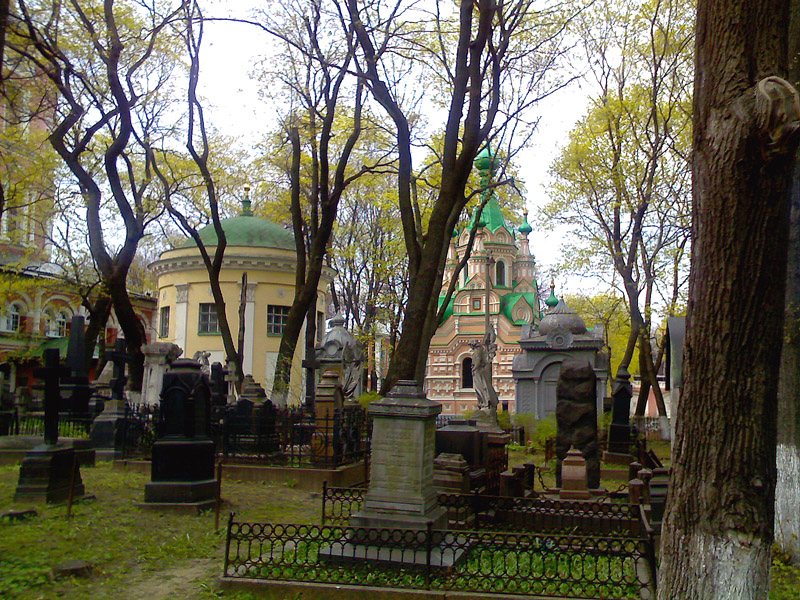
In death, Solzhenitsyn will rest at Donskoi Monastery in Moscow. Donskoi Monastery and its cemetery were always modest, not a destination of dozens of tour buses, like Novodevichii Monastery and its famous graveyard. I lived near Donskoi Monastery during my first year in Moscow, and sometimes went to sweep old leaves off the grave of Mikhail Kheraskov, an eighteenth-century writer I studied in grad school.

I always think of those days when I hear these lines from Aleksandr Gorodnitskii’s song “В Донском монастыре,” (“At the Donskoi Monastery”). Now when I hear them, my thoughts will broaden to remember Solzhenitsyn’s writings and imagine his grave, too, in a place I used to visit.

“Листопад в монастыре. (“The fall of leaves at the monastery.)
Вот и осень,
- здравствуй. (Here’s autumn – Hello.)
Спит в Донском монастыре (
Sleeps at Donskoi Monastery)
Русское дворянство.” (The Russian nobility.”)