Showing posts with label events. Show all posts

Sunday, July 28, 2013

The Translators’ Coven: Fresh Approaches to Literary Translation from Russian… Finally!


If you were to ask me what I enjoyed most at the Translators’ Coven, which I attended at St. Antony’s College in Oxford, England, last month, I’d probably say something like “everything” or “all of it.” Those two days of formal and informal discussion about translation, Russian, and English—mostly Russian-English translation, but with one panel about English-Russian work—were even more fun and informative than I’d expected. Though it’s always difficult to explain what’s so fun and informative (I’ve already tried and failed quite a few times), the lively official coven report, compiled by Boris Dralyuk and available online here in PDF form, should give you a sense of why I had such a great time and why I hope so very much there will be another coven next year. I’ll use this post to amplify and complement certain points in Boris’s detailed report…

So many translators… I think it’s safe to say that everybody was surprised the coven drew so many people: in his opening remarks, Oliver Ready said he and Robert Chandler had expected a much smaller gathering so had to reserve a larger room when it turned out that over 120 people (!) wanted to come. I’m tremendously grateful to Oliver and Robert for organizing the coven, and to sponsors CEELBAS, the Prokhorov Foundation, and the Russkiy Mir Foundation for funding the coven and supporting my travel, care, and feeding. It was a wonderful treat to have a chance to meet, speak with, and listen to so many colleagues from what feels more and more like a true community: the coven added to my impression that Russian-to-English literary translation is experiencing something of a boom, to borrow a word from conversations with one of you. It was especially encouraging to hear how busy everybody is translating and, yes, publishing. I’m already taking entries for the 2014 new translation list.

A chance meeting… Speaking of the value of community, Boris’s report notes that the coven provided a chance for Peter France and Anatoly Liberman to learn, by virtue of speaking on the same panel, that they’ve both been translating Baratynsky (a.k.a. Boratynsky)… but without knowing of each other’s work. I mentioned Peter’s work on Mandelshtam in a previous post about poetry translation events in London the week after the coven; Peter also translates Batiushkov and Annenskii, who was one of my big favorites in grad school. Anatoly spoke of handling various technical problems of poetry translation, such as differing quantities of syllables in Russian and English. Anatoly, by the way, writes the “Oxford Etymologist” columns for the Oxford University Press blog: you can learn about words like “pumpernickel” and “flute” here.

Retranslations… Though I’ve never retranslated anything beyond isolated lines of classics that pop up in contemporary work, I loved the panel on retranslations. Rosamund Bartlett spoke about her work on Anna Karenina, offering very practical bits on topics like Tolstoy’s use of repetition, which she sometimes preserves and sometimes does not, depending on shades of meaning, the value of switching word order in exceptionally long sentences, and the vexing question of feminine surnames. I also appreciated Oliver’s account of spending about five years translating Crime and Punishment, which he wrote out by hand; Oliver, too, mentioned repetition, saying he kept a glossary so he could preserve repetition, as appropriate.

Collaborative translation… Discussion of collaboration was a highlight, too: Anne Fisher spoke about translating poems by Maxim Amelin with her husband, poet Derek Mong: she showed us drafts, beginning with a crib and ending with polished lines, and acknowledged disagreements. After Anne spoke, panel chair Robert Chandler added that he and his wife, with whom he collaborates, sometimes try “something silly” when they’re stuck. I like that approach, too: I often repeat lines over and over to myself, out loud (and, hmm, usually staring blankly at the wall), trying out new words. It often works for me. Robert is, of course, an active collaborator: I’ve been enjoying working on a Platonov story with him and am just getting started on a play. It’s been especially instructive seeing how Robert draws on opinions and advice from experts on Platonov and railroad technology from the early twentieth century. But back to the coven itself! Boris Dralyuk and Irina Mashinski, both of whom are co-editing Anthology of Russian Poetry from Pushkin to Brodsky with Robert, spoke of their work together, using the example of Arseny Tarkovsky’s “Field Hospital” and some of Irina’s poems. It was fun hearing how they work on poetry that Irina did not write: Irina gives Boris a summary of elements in the poem she sees as crucial. I liked Irina’s metaphor of “the bristles of each line” in a poem that the translator should feel.

“Productive” and “rowdy”… Boris’s summary uses those adjectives to describe Chris Tauchen’s presentation about his work on Nikolai Kononov’s short story “Аметисты” (“Amethysts”). Chris asked attendees to look at a problematic passage and offer translation ideas. As Boris notes in the report, “there is little translators like to do more than translate.” He’s right: it was fun talking over ideas with the people sitting nearby… this involved, of course, repeating lines over and over, out loud, trying out new words. I drew on that theme in my own talk about translating dialogue for plays, too, highlighting the importance of intonation.

English-Russian translation… The panel on translating Julian Barnes and Peter Ackroyd from English to Russian was a nice change of pace on the second afternoon: Anna Aslanyan’s observations on looking to Nikolai Karamzin’s Letters of a Russian Traveler for help when she was working on Ackroyd’s Hawksmoor, which is partially set in the eighteenth century and uses spellings like “fabrick” and “agonie,” was reassuring after my work on excerpts from Evgenii Vodolazkin’s Laurus, which contains bits of archaic Russian. Alexandra Borisenko and Victor Sonkin’s presentation on retranslating Flaubert’s Parrot was filled with humor, some of which drew on passages from Soviet translations where meaning was overshadowed by what Boris neatly summarizes as “the prudishness of the Soviet approach.”

The non-coven cows… Finally, I can’t help but mention how much I loved walking around Port Meadow in Oxford with Anne Marie Jackson and dozens of cows the day before the coven. It was just the thing to shake off one plane flight and two bus rides.

http://upload.wikimedia.org/wikipedia/commons/3/37/Cattle_on_the_Port_Meadow_drinking_in_the_River_Thames_-_geograph.org.uk_-_1555144.jpg

Other posts about the coven:
Alan Shaw on Prosoidia, here.
Erik McDonald on XIX век, here. 

Disclaimers: The usual. And, again, my profuse thanks to coven’s sponsors and organizers!

Up Next: Back, finally, to writing about books! Alexander Ilichevsky’s The Orphics, Iurii Buida’s Thief, Spy, and Murderer, and then, at some point in the future, Maxim Kantor’s huge (608 large pages) Red Light/World, which I started last Sunday and am finding very intriguing so far… it reads like a combination of a dishy contemporary novel, a historical novel, and a sociopolitical rant. We’ll see how that goes.

Photo Credit: Sarah Charlesworth, Creative Commons, via Wikipedia


Sunday, May 12, 2013

A Jumble: Two Books, One Coven, and Six Literary Award Finalists

I took a break last week after a rather bloody incident involving a grater, a chunk of Pineland sharp cheddar cheese, and a middle finger. Now that I’m back to full typing capacity, despite an occasional twinge in the finger, here’s a jumble of a post to get me caught up…

I’ll admit that last week I was more than happy to procrastinate writing about Sergei Nosov’s Грачи улетели (The Rooks Have Flown/Left/Gone): in keeping with the jumble theme, The Rooks is a nearly indescribable jumble of characters, places, and motifs. Nosov tells the story of three old friends—a teacher, a typewriter repairman and watchman, and a former flyswatter salesman and would-be artist(e)—in three non-chronological sections. Much of the book is set in St. Petersburg, which lends itself to some nice passages about changing names and times. And references to Dostoevsky. And peeing off a bridge.

I thought The Rooks worked particularly well when Nosov examined contemporary art—one of his characters makes a wonderful trip to the Hermitage and stares in the abyss of Malevich’s glassed-in Black Square—and the fine lines between art and life. The section set in Germany, where the flyswatter salesman and would-be artist lives for a time and hosts the other two for a painful visit, felt less successful because it felt, simply, too long. Despite some structural misgivings, Nosov won me over with atmosphere, love for St. Petersburg, and a tone that avoids the cloying and preciousness thanks, in large part, to tart commentary on contemporary art and culture. The epilogue contains developments that brought varying degrees of surprise and showed how little we may know our friends and literary characters. It also cemented my interpretation of the book’s title as a reference to fall, playing off the name of Aleksei Savrasov’s painting of rooks that have returned in spring.


Iurii Trifonov’s Обмен (The Exchange) is a lovely jumble, too, a long story about family that blends past and present, private and public: Trifonov focuses on Viktor Dmitriev, whose wife Lena wants to arrange an apartment exchange so they (and their daughter) can live with Dmitriev’s mother, Ksenia, who is horribly ill. The description of The Exchange in Neil Cornwall and Nicole Christian’s Reference Guide to Russian Literature is so good and detailed (even if it’s cut off!) that I’ll just focus on impressions. I think what struck me most about The Exchange was the grayness of Dmitriev’s Soviet-era existence: his daily routine, his past affair with a co-worker he thinks would have made a better wife than Lena, and, of course, disappointment. Everything is beautifully observed and described though I find this sort of quiet—or perhaps muted and repressed?—desperation even sadder than the harsher chernukha of the post-Soviet era. I mean that as a statement of respect rather than a criticism. Particularly since I have to think there’s a reason Trifonov chose to include that cesspool.

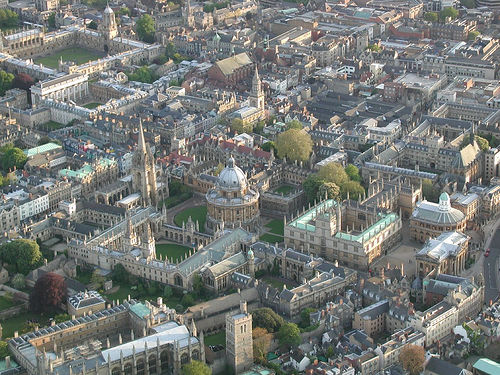
File:Oxford City Birdseye.jpg
Oxford from the air... must get up early enough to see city before coven...
On another note, I’m very excited about Translators’ Coven: Fresh Approaches to Literary Translation from Russian, a weekend workshop I’ll be attending at St. Antony’s College, Oxford, next month. I’ll be chairing a roundtable discussion about publishing and translations, and speaking on a panel about translating dialogue in drama. The week after the workshop, there will be a series of events about poetry translation at Pushkin House in London. A huge thank you to Oliver Ready and Robert Chandler for organizing all this. It’s a wonderful chance to learn and get caught up with London-based colleagues. I can’t wait!

Speaking of which… Pushkin House launched a new book award, the Pushkin House Russian Book Prize, “to further public understanding of the Russian-speaking world, by encouraging and rewarding the very best non-fiction writing on Russia, and promoting serious discussion on the issues raised.” I’m always vowing (and, generally, failing) to read more (okay, any!) book-length nonfiction that complements my fiction reading, so the Pushkin House Russian Book Prize short list, which covers a wonderfully broad assortment of topics, is a convenient place to start looking for candidates:
  • Anne Applebaum: The Iron Curtain: The Crushing of Eastern Europe 1944-1956
  • Masha Gessen: Man Without a Face: The Unlikely Rise of Vladimir Putin
  • Thane Gustafson: Wheel of Fortune: The Battle for Oil and Fortune in Russia
  • Donald J. Raleigh: Soviet Baby Boomers: An Oral History of Russia’s Post War Generation
  • Karl Schlögel: Moscow, 1937
  • Douglas Smith: Former People: The Last Days of Russia’s Aristocracy
FYI: Languagehat has posted about Soviet Baby Boomers and Moscow, 1937. Moscow, 1937 sounds particularly fun…

Reading Levels for Non-Native Readers of Russian: Medium for both the Nosov and Trifonov books.

Writer Names in Russian: Сергей Носов and Юрий Трифонов.

Up Next: A novella (or two?) by Victor Pelevin.

Image Credit: Oxford City Birdseye from SirMetal, via Wikimedia Commons.

Sunday, May 8, 2011

Old News Is Good News

As has become my not-so-good habit, I’ve been hoarding news…

1. Marina Palei won the Russian Prize (Русская премия) recently for her novel Хор (The Chorus/Choir), which is also on this year’s Big Book long list. Many of Palei’s other texts are available on her Web site. Iurii Serebrianskii won the short prose prize for “Destination. Дорожная пастораль” (“Destination. A Road Pastorale”), and Natal’ia Gorbanevskaia won the poetry award. The Russian Prize is awarded to writers outside Russia who write in Russian; background is available here. [Update: For more, in Russian, on the Russian Prize, here's an OpenSpace.ru interview with the prize's coordinator.]

2. A Московские Новости interview with writer Oleg Pavlov mentions that Pavlov’s trilogy Повести последних дней (Tales of Recent Days) will be published in English translation by And Other Stories. The first two books of the trilogy, in an edition that Oleg kindly brought to London for me, are waiting on the Bookshelf. Pavlov’s interview answers are quite candid as he discusses presentations at the book fair, reactions to the Russian booth, and politic aspects of who goes abroad to fairs.

Pavlov also says only three social novels came out of the noughties: his own Asystole/Flatline, Zakhar Prilepin’s Sank’ya, and Roman Senchin’s The Yeltyshevs. I’m sure I’d think of another title or two to offer for consideration if I went through my blog archives but – given my admiration for (and work on) Senchin’s book, my appreciation for the difficult but very affecting Asystole, and Sank’ya’s up-close look at political opposition and violence – I would certainly agree that these three novels are some of the decade’s most important social prose. They form a bleak triptych of various types of post-Soviet social breakdowns and disconnects.

3. Meanwhile, the book fair circuit continues: Russia is the guest country at the Salone Internazionale del Libro di Torino, which opens on giovedi, 12 maggio. And what better way to practice your Italian than reading the program? Some of the same writers who were in London – e.g. Liudmila Ulitskaya, Mikhail Elizarov, Zakhar Prilepin – will be there, as will Sasha Sokolov, Viktor Erofeev, and Julia Latinina. And film director Aleksandr Sokurov.

4. Finally, for those of you who will be in the New York area in late May: Causa Artium will host Olga Slavnikova in events on May 20, 22, and 25 in, respectively, Jersey City, Brooklyn, and Manhattan. Marian Schwartz, who translated 2017, will participate in the event on May 25, in Manhattan. I’ll be there, too! Each Slavnikova event will be followed by a “New Faces, New Voices: Rising Stars of Russian Writing” program featuring four winners of the Debut Prize. I enjoyed hearing two of these writers speak in London so will make sure to have an extra afternoon coffee so I can stay for the second half of the evening. And stay awake after a day at Book Expo America. All the events are free. RSVP on Causa Artium’s Facebook listings, if you’d like.

Up Next: Aleksandr Snegirev’s Тщеславие (Vanity), then Mikhail Shishkin’s Венерин волос (Maidenhair).

Disclosures: Standard disclosures apply.