- Leonid Yuzefovich’s Зимняя дорога (excerpt 1) (2) (3) (Winter Road) (12 points). I’ve been looking forward to Winter Road—which describes itself as a documentary novel—ever since it arrived at my house a month or so ago: I feel like I can’t go wrong with the combination of “documentary” and “novel” as well as, of course, Yuzefovich, Civil War figures, and Yakutia, a place I once spent several very wintery days.
- El’dar Sattarov’s Транзит Сайгон-Алматы (literally Transit Saigon-Almaty) (9 points). Sattarov’s apparently a fairly unknown writer from Kazakhstan: the book looks at the history of Vietnam during 1930 through the 1990s, apparently through the story of a partisan.
- Aglaya Toporova’s Украина трех революций (excerpt 1) (2) (3) (very literally Ukraine of Three Revolutions) (8 points). Levental notes Toporova’s “centrist position” and “calm ironic intonation” in describing events in Ukraine in recent years.
- Maria Galina’s Автохтоны (part 1) (part 2) (Autochthons, I guess) (7 points). Autochthons sounds like a Galina-esque combination of phantasmagoria, magical realism, history, and a regular-guy hero. I’ll be starting on this one soon, too.
- Mikhail Odnobibl’s Очередь ([The?] Line) (5 points). Even Levental calls this one mysterious; he also describes the book as “Kafkaesque fantasy.” Beyond that, it’s unclear who Odnobibl really is. (An all-too-quick-because-it’s-a-sunny-day search for descriptions popped this piece, which I may take a better look at when the sky’s cloudier.)
Saturday, April 30, 2016
2016 National Bestseller Award Short List & The Penguin Book of Russian Poetry
The National Bestseller Award announced its short list this week. Here’s
the list of five finalists—one short of the usual six—with the number of points
each was awarded in the first round of voting. Comments on the finalists and the process,
written by Vadim Levental, the NatsBest secretary, are online, as are jury
members’ reviews and votes.
Levental also mentions notable authors who missed the short
list… picking up many of the same names I did: he praises Alexander Snegirev’s collection
of short stories (which Snegirev sent to me and which looks very good), and Anna
Matveeva’s novel but said he breathed a sigh of relief that Petr Aleshkovsky
and Anatoly Kim missed out. I, too, was surprised that Andrei Astvatsaturov and
Dmitrii Danilov received only one point each.
The NatsBest winner will be announced on June 5.
Bonus: A Rambling, Non-Scholarly,
and Occasionally Gushy Translated Book Note. I finally (finally!) ordered
up a copy of The Penguin Book of Russian
Poetry, edited by Robert Chandler,
Boris Dralyuk, and Irina Mashinki, and containing translations by the editors plus
a stellar list of several dozen additional translators, beginning,
alphabetically, with Alexandra Berlina and ending with Katherine Young. I
bought the anthology for what might be called “business with pleasure” reasons:
for one thing, Russian novels often contain lines from well-known Russian
poetry, transforming anthologies into reference books for me. For another, I
like anthologies with introductory notes about authors and this book’s notes,
written by Chandler and Dralyuk, are lively and informative. I also feel a special
connection to the book after hearing related translator readings and conference
presentations in June 2013 (previous
posts).
Though I’ve only puttered with the book a little since I
bought it on Tuesday—flipping to random pages and poets as I’m wont to do with
collections like this and floating off on happy little tangents—I did take a closer
look at one poem, Velimir Khlebnikov’s “Заклятие смехом,” which Christopher
Reid’s “after Khlebnikov” interpretation renders as “Laugh Chant.” And which I
liked very much because it tied my tongue and made me laugh, just like the original
does when I read it aloud. I zaumed in on “Laugh Chant” thanks to Amateur
Reader (Tom), who blogs at Wuthering Expectations, and who happens to be on a
Russian poetry tear that’s included a recent post
about The King of Time: Selected Writingsof the Russian Futurian, a 1985
volume with poems translated by Paul Schmidt. Although the beginning of Schmidt’s
version of Khlebnikov’s laughter poem didn’t catch my feel for the poem like
Reid’s does, the beautiful incantatory effect of Schmidt’s neologisms, rhyme,
and even shifted hyphens (!) in a chunk of Khlebnikov’s play-that's-more-than-a-play, Zangezi, that appears in the Penguin collection
bewitched me completely. Zangezi, by
the way, was performed in the late 1980s; read about it in The New York Times, here.
For a comparison of these same two versions of the laughter poem (as well as mentions of other humorous
poems) see Alice E.M. Underwood’s Russian
Life article, here.
Disclaimers: The usual
as well as warm collegial/professional/personal relations with the editors of
the Penguin book and many of the translators therein. I’ve translated excerpts of
books by Galina as well as Vadim Levental’s entire novel Masha
Regina, which is just out from Oneworld Publications and has even been
spotted in the wild at McNally Jackson Books in New York City!
Up Next: Eugene Vodolazkin’s The Aviator, which I just
plain loved. Alexander Snegirev’s Vera, which I may yet call Faith.
Translations due out in 2016—send in those entries!
Posted by
Lisa C. Hayden
at
7:15 PM
5
comments
Labels: contemporary fiction, Leonid Yuzefovich, literary translation, Maria Galina, National Bestseller, poetry, Velimir Khlebnikov
Sunday, April 24, 2016
The 2016 Big Book Award Long List
The Big Book Award announced its long list on
Wednesday and, yes, I was delusional in thinking I’d blog about it during the
week: the most I accomplished before the weekend was placing orders for a few of
the books! The list of finalists will be announced by the end of May. Here are
some of the books on the long list, in alphabetical order within my categories:
Books I’ve already read:
- Yuri Buida’s Цейлон (Ceylon) (previous post), which combines the personal and the historical in a fairly balanced, disciplined novel about a family.
- Evgeny (Eugene) Vodolazkin’s Авиатор (The Aviator), which I finished the other night and loved for its blend of genres, epochs, and themes, some familiar from Laurus and Solovyov and Larionov.
Books already on the shelf or on order; I’ve read other
books by all but one of these authors:
- Vasily Avchenko’s Кристалл в прозрачной оправе (excerpt) (Crystal in a Transparent Frame), which describes itself as “stories about water and rocks” and focuses on Vladivostok. Shortlisted for last year’s NatsBest; quite possibly destined for beach reading, given the coastal theme.
- Pyotr Aleshkovsky’s Крепость The Citadel, which I bought after reading the beginning of the PDF that Aleshkovsky’s literary agency sent me: archaeology and medieval constructions caught me.
- Aleksandr Arkhangelsky’s Правило муравчика. Сказка про бога, котов и собак (excerpt) (The Purrer Rule. A Tale About God, Cats, and Dogs (a terribly troublesome title, thanks to the word I’ve rendered here, for now, as “purrer,” which Arkhangelsky says plays on the Russian term for the right-hand rule, which I didn’t know existed in either language, and “mur,” which is purr.)), which I’m a little skeptical about because I don’t often do well with fables and parables. But Arkhangelsky clearly knows cats.
- Maria Galina’s Автохтоны (part 1) (part 2) (Autochthons, I guess), which sounds like a Galina-esque combination of phantasmagoria, magical realism, history, and a regular-guy hero.
- Dmitry Danilov’s Есть вещи поважнее футбола (There Are Things A Little More Important Than Football/Soccer), which I bet I can read now that I have new glasses! Danilov is one of the only authors I’d trust to keep me reading a book about soccer. (This is already shaping up to be quite a season: ocean, cats, soccer…)
- Aleksei Ivanov’s Ненастье (Foul Weather), which is apparently about an Afghan War veteran who robs an armored car. I enjoyed Ivanov’s Geographer (previous post) and a couple of my Goodreads friends seemed to love this book… (I hope I do, too, since it’s 638 pages!)
- Igor Savyelev’s Вверх на малиновом козле (Upwards, in a Puce Vehicle; the cover illustrates this pretty nicely and you can see the vehicle is a Jeep-like vehicle, one that has all sorts of slangy nicknames, like the goat in the title), involving a young lawyer going to Abkhazia for his wedding. I’ve enjoyed reading Savelyev in the past and, well, another wedding novel set in the Caucasus sounds natural after reading Alisa Ganieva’s Bride and Groom (previous post).
- Ludmila Ulitskaya’s Лестница Якова (Jacob’s Ladder), a family saga set during 1911-2011; I read the beginning after Ulitskaya’s agent sent me the text.
- Leonid Yuzefovich’s Зимняя дорога, (The Winter Road), which is described as a “documentary novel”: the cover sums up the details with “General A.N. Pepeliaev and anarchist I.Ia. Strod in Yakutia. 1922-1923.”
Here are some others that sound especially interesting for various reasons:
- Sergei Kuznetsov’s Калейдоскоп (excerpt) (Kaleidoscope), dozens of characters and their stories, set in the twentieth century; one of my Goodreads friends just started it and said she was enjoying it, noting sex and vampires.
- Boris Minaev’s Мягкая ткань (Soft Fabric; these links only lead to the first book, Batiste, within what must be a planned multiple-volume novel/series…), which I know nothing about other than that it’s set around the beginning of World War 1 and a friend (real-life, this time) absolutely loved it.
- Sasha Okun’s Камов и Каминка (Kamov and Kaminka), which purports to involve art and a detective story; titled for two artists.
- Valerii Khazin’s Прямой эфир (Live Broadcast) is intriguing because the cover makes it look like a romance novel and the description says it’s a detective/adventure novel about a man running from terrorists… but Alexander Gritsman, writing for Interpoezia, focuses largely on its poetic aspects. (I admit I made a very superficial skim of his piece: I don’t want to spoil the book for myself with details.)
- There are also several books about writers that I’ll list without titles: Aleksei Varlamov on Vasily Shukshin; Zakhar Prilepin on Anatoly Mariengof, Boris Kornilov, and Vladimir Lugovskoi; and Dmitrii Bykov on Vladimir Mayakovsky (submitted as a manuscript and listed as such on the Big Book site).
I could go on and on (and on) about the other half of the
list but will stop there pending announcement of the finalists next month.
Disclaimers: I’m a member of the Big Book’s jury,
the Literary Academy, and will vote on finalists later this year. Authors and
literary agents have given me electronic copies of several of these books.
Up Next: The National Bestseller Award’s
short list. Vodolazkin’s The
Aviator,
which truly does soar. Alexander Snegirev’s Vera, which I may yet call Faith. Translations coming out in
2016—send in those entries!
Posted by
Lisa C. Hayden
at
4:01 PM
2
comments
Labels: awards, Big Book, Big Book 2016 finalists
Sunday, April 10, 2016
Akunin’s Black City
A bit of backstory: the beginning of Akunin’s novel was
first published in Le Figaro, which
in 2008 solicited a series of stories celebrating Homer. Apparently all
the pieces Le Figaro published in the
series begin with that line, which also happens to begin the fourteenth book of
The Odyssey. Caveat: since I haven’t read
The Odyssey (ouch!), I’m not sure
what other elements Akunin may have borrowed. I can say that Akunin’s Odysseus
is, initially, in Yalta in 1914. So is Fandorin, on a Chekhov-related mission. Odysseus
commits murder and absconds to Baku meaning, of course, that Fandorin goes to
Azerbaijan, too, both to hunt down Odysseus and to deliver trunk of clothes to
his wife, the actress known as Klara Lunnaya, who’s making a film in Baku. Phew.
Well. Well. I’ve
long had a sentimental soft spot for Akunin’s Fandorin novels because it was the
unexpected gift of a Fandorin Book, Любовница смерти (known as She Lover of Death in Andrew
Bromfield’s translation), that got me reading contemporary Russian fiction a
decade or so ago. But, as I’ve
noted before, my interest in Akunin’s Fandorin series dropped off rather
sharply after He Lover of Death—the
ninth book in the Fandorin franchise: I wasn’t even able to finish all four
that came after that—and more than one Russian reader has suggested to me that
Akunin исписалcя, wrote himself out, after He Lover of Death.
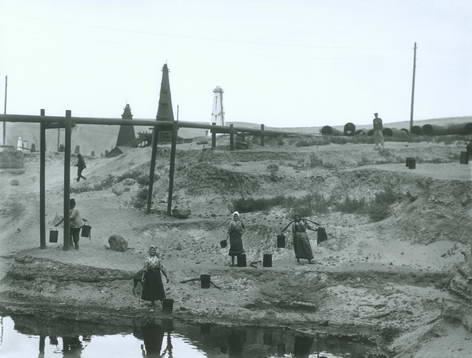
| Pipeline, Black City, 1905 |
Will the loony Klara and Fandorin (who clearly disdains her
and recognizes her use of her stage characters’ speeches in real life) stay
together despite her cinematic suitor? Will Fandorin and his local sidekick
Gasym, who mangles Russian grammar, catch the bad guys? Will the merry petroleum
widow whose eunuch servant serves as a fixer (and voyeur, too: I think this bit
player is one of the book’s most interesting characters) for her assignations
set her eye on Erast Petrovich and lure him to her home? And, since someone
somewhere referred to The Black City as
containing alternative history: will the world erupt in war after the events in
Sarajevo? I’ll never tell. All in all, I think I got more enjoyment from
surfing for background on turn-of-the-last-century Baku and looking
at old online photographs than reading The
Black City, which lacks pep and pop, and feels all too much like a franchise
novel.
Up Next: Eugene
Vodolazkin’s Aviator and Alexander
Snegirev’s Vera, both of which I’m
enjoying, in very different ways. The Big Book longlist is coming soon, too. Also:
translations due out in 2016. Translators and publishers, please let me know
what you have scheduled for release this year!
Photograph by Carl Bulla (who sounds like
a pretty interesting character himself!), via Wikipedia.
Posted by
Lisa C. Hayden
at
6:24 PM
5
comments
Labels: Boris Akunin, contemporary fiction, detective novels
Monday, March 21, 2016
Lazy Snow Day Special: Grigorenko’s Mebet
I’m not quite sure why I feel so surprised about how much I
enjoyed Aleksandr Grigorenko’s Мэбэт (Mebet,
watch for spoilers!), a novel Grigorenko apparently used to describe as, simply,
“about the taiga.” Despite lots of great reviews and recommendations, I’d been
passing over Mebet on my shelf for almost
four years, always thinking, I suppose, that a book about a taiga warrior sounded
too frozen, anthropological, ethnographic, folkloric, frozen (did I mention
that already?), and, thus, uninteresting to pick up. Obviously, I was wrong.
Mebet is anything
but uninteresting, probably because Grigorenko so successfully channels what is
frozen, anthropological, ethnographic, folkloric, and (again) frozen into the story
of one man’s successes (mostly in hunting, often done in others’ territory, and
in battle with neighboring peoples, sometimes using tricks) and failures
(mostly in dealing with other human beings). What struck me most was Grigorenko’s
portrayal of Mebet’s, hmm, rigid character. Don’t get me wrong: a man who can
catch flying arrows deserves some big-time praise, but I jotted down “a hardass
with no friends.” Mebet, a Nenets
who’s a darling of the gods, sees no reason to back down from anything because he
sees people as being either weak or strong and he believes there’s no reason to
deny one’s category. I’m sure it’s clear which category he inhabits. Mebet even tells his son, Khadko, that there’s just one area where he’s incapable:
regretting past deeds or repenting. (That sets up the second half of the book;
more on that below.)
Mebet and Khadko have a strained relationship, thanks to differences
in their worldviews: Khadko may be a fantastic hunter but, unlike his father, he
wants to observe the rules of the taiga that humans have set. In a key
disagreement, Khadko follows those rules and proposes marriage properly to a woman
from another tribe; he’s refused and told, in part, that it’s because his
father doesn’t honor gods or guidelines, and wants only for others to fear him.
Khadko marries a different woman; Mebet chooses her and kidnaps her for Khadko.
She is Khadne (her name means Woman of the Blizzard) and she turns out to be very
helpful in battle against her own people.
What I’ve outlined is only a portion of the story, to show some
of the factors that lead to further confrontations in the book, after Mebet
goes to take revenge on a bear and loses, which forces him to, well, face his
mortality, his wrongdoing, and those he has wronged. Those people range from his
battle victims to a one-eyed witch who made mushroom potions that Khadko tried.
During a hellish eleven-stage quest, Mebet runs into the spirits of many of
those people and is aided by his very wise talking dog. Like Mebet’s prideful
character, many of the realizations that come—about immortality, being manipulated,
and how scary it is to be a human (or even a dog?)—feel universal rather than unique
to the taiga, despite belonging so solidly in Mebet.
For this reader, the biggest miracle of Mebet
isn’t what happens in the end but that the novel works so beautifully, making
a 239-page book feels like the epic literature that reviews promised. The
matter-of-fact storytelling, the timeless characters speaking everyday-sounding
Russian (they even say “oy”), the narrator’s occasional contextualizing, and
the many familiar tropes Grigorenko folds into the text all make Mebet read easily, but the more I go
back to look at my notes and reread individual pages, the more I appreciate—as I
always do—how much depth an author can work into such a seemingly simple text. Mebet made for particularly good company
during a particularly busy time: it’s not easy to find books that read this smoothly,
pleasantly, and smartly on multiple levels.
Up next: Boris
Akunin’s The Black City, set in Baku;
fun in spots but dragging a bit. Eugene Vodolazkin’s The Aviator, which I’m reading slowly and enjoying very much.
Posted by
Lisa C. Hayden
at
6:22 PM
0
comments
Labels: Aleksandr Grigorenko, contemporary fiction, post-Soviet fiction
Sunday, March 13, 2016
2015 Compass Award Results
I don’t read nearly as much Russian poetry as I should so the
Compass Award, an annual translation contest, is a welcome way to get me
thinking about poetry, one poet at a time. Boris Slutsky
was the poet to translate for the 2015 contest year; winners were
announced in early January. I somehow missed that, most likely thanks to my working-through-the-holidays
haze, but announcements about yesterday’s ceremony and reading in New York City
woke me up. I wish I could have gone! The winners are:
First prize: Peter Oram for “Poetic Proof.” I
remembered Oram’s name from last year’s Joseph Brodsky/Stephen Spender Prize,
where Oram won second place with a very striking translation. (Previous
post)
Second prize: Robin Kallsen for “Twentieth Century”
Third prize: Robin Kallsen for “There is a God”
Honorable Mention: Lawrence Bogoslaw for “People Fall Into 2 Camps”
Second prize: Robin Kallsen for “Twentieth Century”
Third prize: Robin Kallsen for “There is a God”
Honorable Mention: Lawrence Bogoslaw for “People Fall Into 2 Camps”
The winning translations will be published in Cardinal Points Journal (vol.
6, March 2016) and the Storony sveta literary
annual, in February 2017.
For more on Slutsky, I’ll turn things over to Jamie
Olson, who’s posted twice about him. Click here for Jamie’s “Holding a Gaze,”
which translates “О прямом взгляде,” and
here
for some thoughts on how Slutsky’s poetry reflects the times he lived in. Writes
Jamie, “Throughout his work, Slutsky seems haunted by Soviet history and
therefore intent upon revisiting it so as to comprehend it. By candidly
examining his own past and thoughts, he emerges as both judge and interlocutor,
providing an ethical context in which author and reader can interpret events
together.”
I would be remiss if I didn’t mention that Compass chose Bella
Akhmadulina as the poet for the 2016 award. Just for fun, to get you ready,
let’s reprise this piece by
Alexander Anichkin from Cardinal
Points, about Akhmadulina’s “По улице моей” (“Along
this street of mine”).
Up Next: Aleksandr
Grigorenko’s Mebet then Boris Akunin’s
Black City, a Fandorin novel that
takes place in Baku (one of my favorite places to visit for work when I lived
in Moscow). After the adrenaline rush of meeting three deadlines in two weeks—and
a lovely bouquet it was, with a novel, a short story, and an article—it’s nice
to hang out with Erast Petrovich for a little while and enjoy a different kind of
adrenaline rush. I’ve got a nice pile of books to choose from after that…
Disclaimers: Irina
Mashinski editor-in-chief of StoSvet, which runs this award, is a wonderful
colleague.
Posted by
Lisa C. Hayden
at
5:54 PM
0
comments
Labels: awards, Boris Slutsky, poetry
Subscribe to:
Posts (Atom)